Marketing Strategy · Updated July 9, 2026
Music Promotion Services for Artists: Legit vs Risky
Most artists searching for music promotion services are not looking for magic. They are usually looking at a song they care about and thinking, "Cool, now how do I get the right people to hear this?"
That is a fair question. The problem is that the phrase "music promotion service" can mean almost anything: Spotify playlist pitching, TikTok creator posts, YouTube ads, PR, radio, social media management, smart-link funnels, influencer campaigns, or a full release strategy.
Quick answer: the best music promotion service depends on the bottleneck. If nobody knows the song exists, you need discovery. If people click but do not save, you need better positioning or a better song angle. If streams spike and vanish, you need cleaner listener quality. If every release resets from zero, you need a system that captures fan data and teaches you what to repeat.
Music Promotion Services for Artists: Match the Bottleneck
The best service is the one that fixes the problem in front of you.
| Artist problem | Useful service type | What to measure |
|---|---|---|
| The song needs first discovery | Short-form content, YouTube, playlist pitching, or targeted ads | Views that turn into saves, follows, comments, and link clicks |
| The release needs credibility | PR, blogs, podcasts, local press, or creator coverage | Relevant mentions, search footprint, profile visits, and fan actions |
| You need listener data | Spotify and Meta ads, smart links, and analytics review | Save rate, repeat listening, follows, source quality, and audience fit |
| You need a repeatable system | Release strategy, content testing, paid traffic, fan capture, and reporting | What you can repeat on the next song |
Before you pay anyone, you should be able to explain what they will do, where the audience will come from, and what you will know when the campaign ends.
Are music promotion services legit?
Some music promotion services are legit. A legit service can explain the channel, the audience, the expected learning window, the reporting, and the risks. It does not hide behind vague language like "organic exposure" while refusing to tell you where the attention comes from.
The risky services usually sell certainty: guaranteed streams, guaranteed playlist placements, guaranteed viral posts, guaranteed charting, or suspiciously cheap packages that promise huge numbers without explaining listener quality.
Ask what fans should do after they see the campaign. Save the song? Follow the artist? Watch another video? Join a list? If nobody can answer that, the package is selling activity instead of progress.
If the answer is only "more numbers," slow down.
What music promotion should do
Good promotion should help you get in front of the right people and learn something useful about them.
The useful signals are not complicated:
- Saves: people liked the song enough to keep it.
- Follows: people want the next release, not only this stream.
- Repeat listening: the song has real pull after the first click.
- Personal playlist adds: listeners are putting the song into their own life.
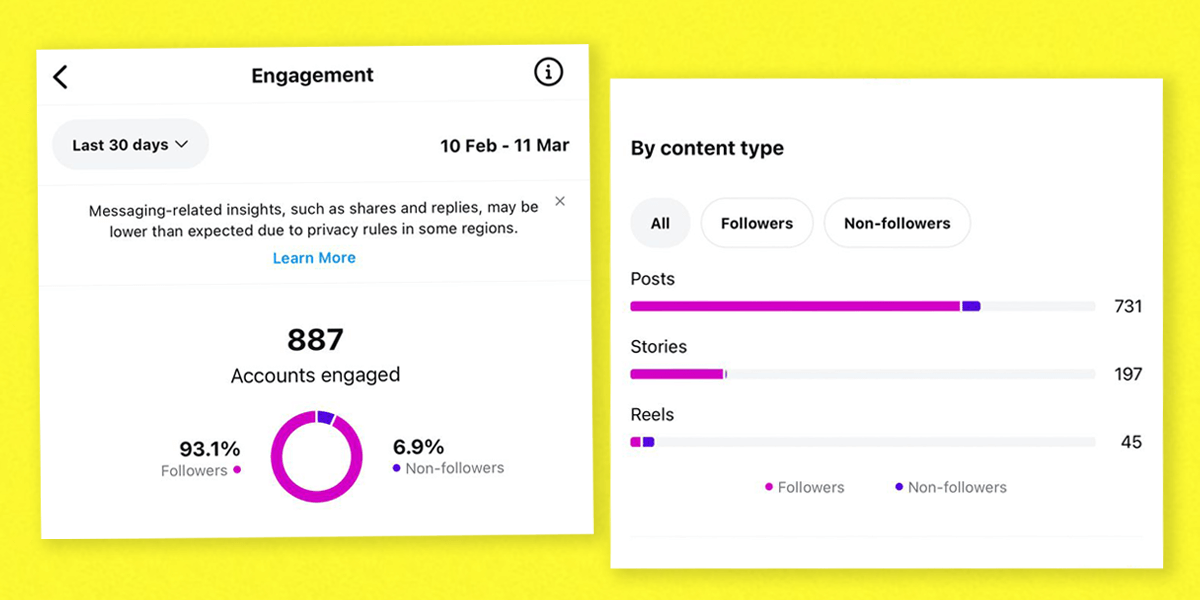
- Comments, shares, emails, and DMs: the campaign is creating relationship, not only reach.
- Audience clarity: you learn which scenes, cities, similar artists, hooks, and content angles respond.
A campaign that creates those signals can make the next release smarter. A campaign that only creates a temporary spike usually leaves you right where you started.
Real Music Promotion Services vs Fake Growth
Real music promotion services can explain the channel, the audience, the setup, and the reporting before you spend.
Fake growth hides the source. It sells a number, then leaves you with streams from listeners who do not save, follow, share, come back, or fit the artist's genre.
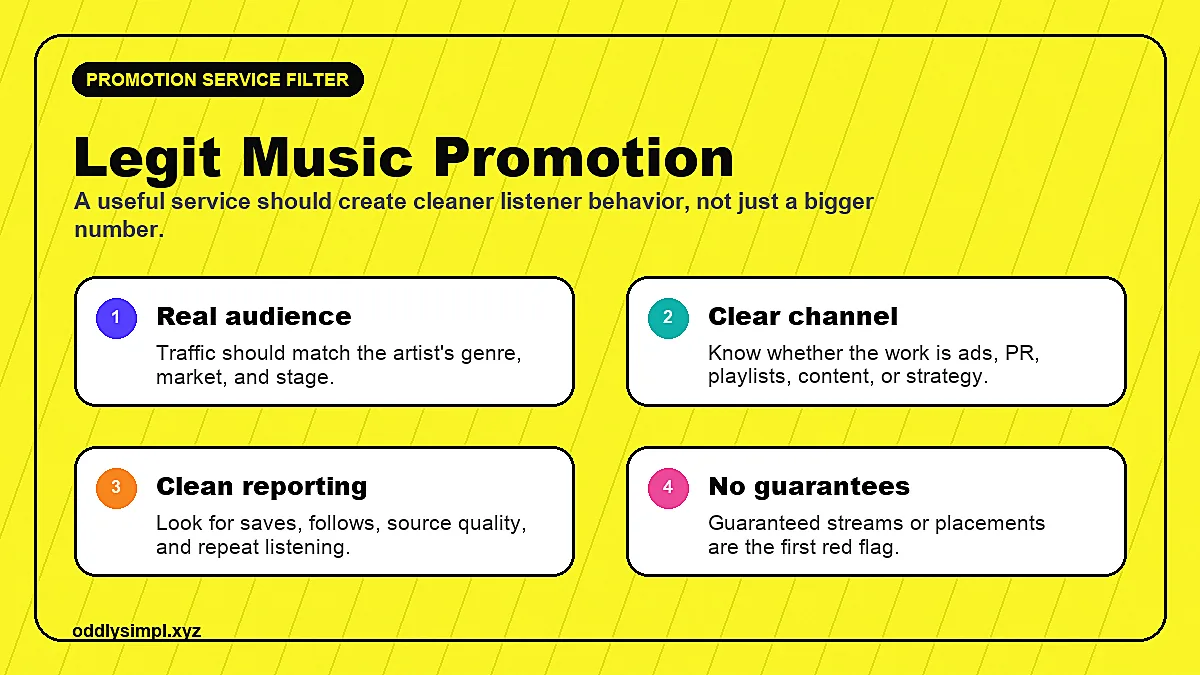
A promotion package is easier to judge when you can answer four questions:
- Can they explain where the audience comes from?
- Can you see saves, follows, repeat listening, playlist adds, comments, profile visits, or link taps?
- Can they tell you what they will change if the campaign attracts the wrong listeners?
- Can you use the result to make the next release smarter?
If the offer only promises streams, views, or playlist placement, treat it as a red flag.
The main types of music promotion services
There is no single "best" music promotion service. There is only the best fit for the job.
Spotify promotion services
Spotify promotion services usually include playlist pitching, ads, submission tools, or done-for-you campaign management.
The safest version is transparent about the source of traffic and focused on listener behavior: saves, follows, repeat listening, source of streams, audience geography, and similar-artist quality.
The risky version sells guaranteed streams or guaranteed playlist placements. Those offers can create bad data, suspicious listener patterns, and a false sense of progress.
For the deeper breakdown, read the Spotify promotion services guide.
Playlist promotion services
Playlist promotion can be useful when the curator fit is real and the playlist audience makes sense for your song. It can also be overrated because playlist listeners are often passive. They may stream the song without remembering the artist.
Do not judge playlist promotion by stream count alone. Watch save rate, follower growth, repeat listeners, audience location, and whether the playlists fit the genre or mood.
If you are comparing tools, use the Playlist Push alternatives guide before buying a campaign.
TikTok music promotion services
TikTok promotion can help when the song has a clear moment: a lyric, transition, hook, emotional line, danceable section, or story that creators can use.
The mistake is buying creator posts before you know what angle makes strangers care. Test the song moment organically first. Then use paid creator campaigns or ads to scale the angle that already has proof.
For the tactical version, read how to make your song go viral on TikTok and the TikTok content template for musicians.
YouTube and music video promotion services
YouTube promotion is more than running ads to a video. The video title, thumbnail, hook, retention, Shorts/Reels cutdowns, landing path, and release timing all affect whether a campaign creates fans or empty views.
If your goal is a music video campaign, start with the music video promotion guide. It covers YouTube-specific setup, short-form cutdowns, paid amplification, and how to measure fan actions after the view.
PR and blog promotion
PR works best when there is a real story: a release with a clear angle, a local scene, a visual world, a collaboration, a tour, a cultural hook, or a founder-level narrative people can repeat.
PR is useful for credibility and search footprint. It is not always the fastest way to create streams. Use it when the story matters, not when you are trying to force attention onto a song with no angle.
Paid ads and full campaign systems
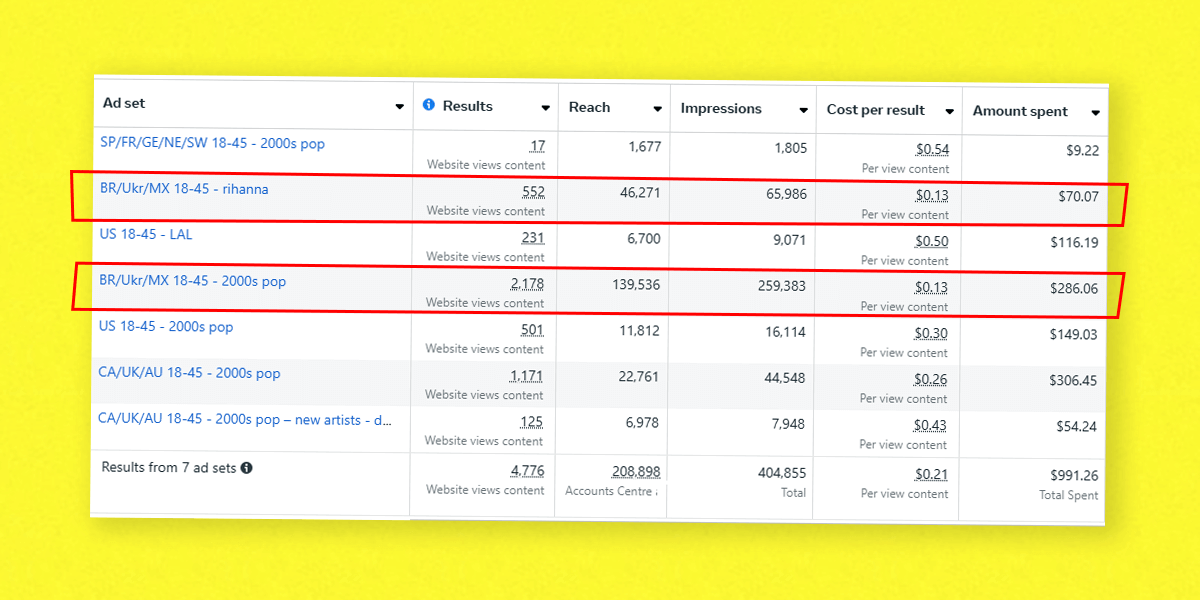
Paid ads are often the cleanest way to learn because you can control the audience, creative, budget, and reporting. A real ad campaign tests different listener groups and song angles instead of buying traffic blindly.
Which similar artists work? Which hook gets saves? Which country listens twice? Which clip earns follows? Which audience creates cleaner Spotify data?
That is the lane simpl. cares about most: music promotion that helps the artist understand who cares.
If you want that built for you, start with simpl's Spotify ads for artists.
Best Music Promotion Websites: Build a Small Stack
No music promotion website handles every part of a release well. The useful setup is usually a few focused tools, each with one clear job.
The best music promotion services usually sit inside a stack, not above it. One tool handles submissions, another handles links, another handles analytics, and a strategy partner helps decide what the data means.
The better move is to build a small promotion stack by job:
- Official Spotify tools: use Spotify for Artists to pitch unreleased music, build followers, understand audience behavior, and access eligible campaign tools.
- Submission websites: use platforms like SubmitHub, Groover, SubmitLink, One Submit, or DailyPlaylists when you want to pitch curators, blogs, creators, or playlist owners yourself.
- Smart-link and pre-save tools: use these when you need platform choice, click data, retargeting audiences, and release-day tracking.
- Analytics tools: use Spotify for Artists, Chartmetric, Soundcharts, artist.tools, or a simple spreadsheet when you need to diagnose whether promotion created saves, follows, repeat listeners, or suspicious traffic.
- Managed campaign help: use an agency or ads partner when you need strategy, creative testing, audience interpretation, and someone to turn the data into the next decision.
The "best" website is the one that solves the current bottleneck without pretending to solve the whole career. A playlist submission website can help with outreach. It will not write your positioning, fix weak content, build a release system, or explain why a campaign produced streams but no fans.
Music promotion services Reddit gets right
Reddit threads about music promotion services are usually skeptical because many artists have been sold fake certainty.
That skepticism is healthy. Use it as a filter:
- Does the service explain where the traffic comes from?
- Do artists mention saves, follows, and repeat listeners, or only streams?
- Are there complaints about weird countries, bot-like spikes, or zero retention?
- Does the company guarantee numbers that real humans cannot honestly guarantee?
- Does anything useful remain after the campaign ends?
Do not assume every promotion service is a scam. Also do not ignore the pattern when artists keep saying a service created a spike with no fanbase.
How to choose the right service
Match the service to the bottleneck.
| If your problem is... | Consider... | Avoid... |
|---|---|---|
| Nobody knows the song exists | Ads, creator testing, playlist pitching, release content | Guaranteed-stream packages |
| You need credibility | PR, blogs, EPK cleanup, local press | Generic blast lists with no story angle |
| You need Spotify listener data | Spotify ads, Meta ads to smart links, analytics review | Anonymous playlist traffic |
| You need content ideas | TikTok/Reels/Shorts testing, creator feedback | Buying posts before testing song moments |
| You need a release system | Release strategy, smart links, ads, analytics, retargeting | One-off promo that ends after release week |
If you cannot name the bottleneck yet, start with the music marketing strategy guide and check the numbers against the music analytics guide. Once the problem is clear, the comparison of music marketing companies for independent artists will make more sense.
What simpl. does differently
simpl. is not trying to be a marketplace for every promotion channel.
The work is more specific: we help artists use paid ads, listener data, content angles, and release strategy to find real audience signal. That means no fake playlists, no guaranteed streams, no mystery traffic, and no campaign report that only tells you the graph went up.
The question we care about is simple: did this campaign help us understand who is most likely to become a real fan?
If yes, we can build on it. If not, we stop pretending the spike meant something.
For a broad comparison of agency types, read music marketing companies for independent artists. For Spotify-specific risk, read what Spotify promotion services are legit. For done-for-you listener testing, book a Spotify ads strategy call.
Keep building the strategy
-
Music marketing strategies
Build the full system around content, ads, release timing, and fan retention.
-
Music analytics
Use listener data to make better release, content, and ad decisions.
-
Spotify ads for artists
Turn the right listeners into repeat fans with a campaign built around your sound.
About the author

Anthony Pacheco
Anthony Pacheco is the founder of simpl., a former Sony Music analyst, and a Billboard-charting musician who has helped run 750+ artist marketing campaigns. He writes about real listener behavior, release systems, Spotify ads, and how artists can grow without fake playlist traffic.