Marketing Strategy · Updated July 9, 2026
Music Marketing Strategies: 2026 Plan for Artists
A music marketing strategy is the plan that connects the song, audience, content, channels, and follow-up.
For independent artists, a useful campaign makes TikTok, playlists, ads, PR, Spotify data, and release planning point at the same audience and the same next action.
The useful version answers five questions before you spend money:
- Who is this music for?
- Why should they care before they hear it?
- Where will they discover it?
- What should they do after they listen?
- How will we know if the campaign worked?
If you cannot answer those, you do not have a marketing plan yet. You have tactics floating around and hoping to bump into each other.
I learned this the hard way with my own band, Dwellings. We had music people cared about, but the growth was not automatic. The shift happened when we stopped waiting for discovery and started treating each release like a campaign: content, ads, audience testing, playlist strategy, press, and data all working together. That same system helped us build the audience, land press, and chart on Billboard.
The 2026 version for independent artists looks like this.
If you want help building and running the system, see how simpl. works as a music marketing agency for independent artists. If you are still comparing options, compare the music marketing companies for independent artists against the plan you need. A useful proposal should tell you which channel it will use, who it expects to reach, and what you will see in the reporting.
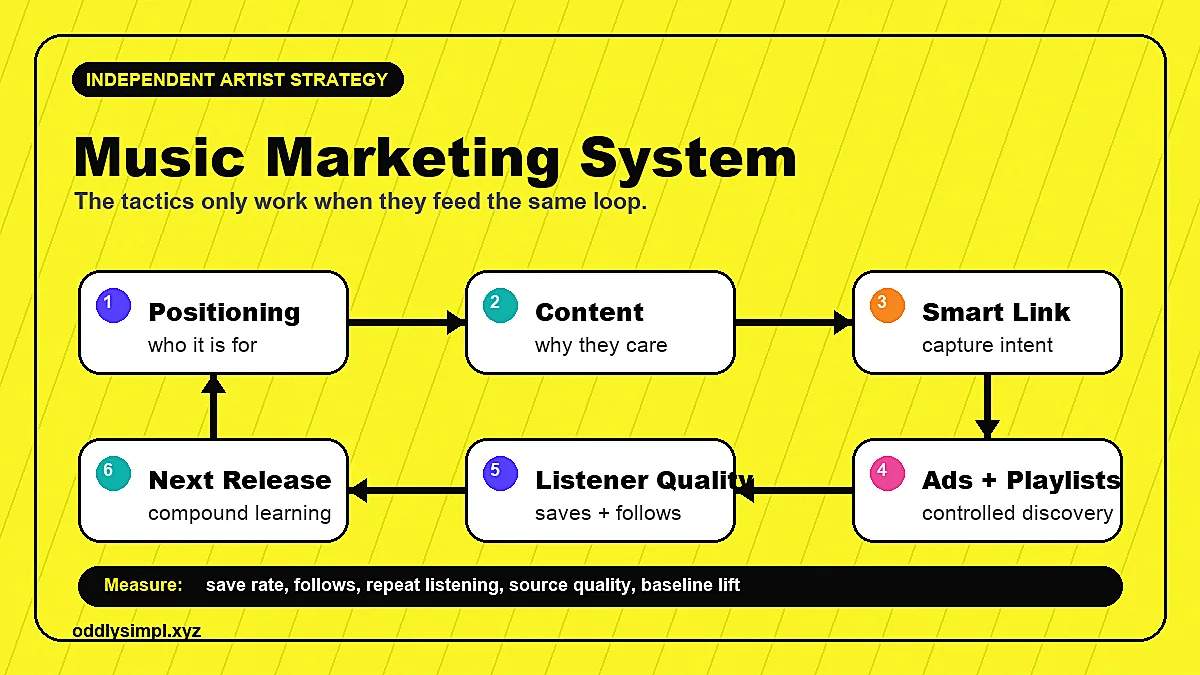
Music Industry Marketing Strategies That Still Work
The music industry keeps changing, but the useful strategies are still practical: define the audience, make the song easier to understand, give fans a reason to act, capture the people who care, and measure whether listeners come back.
That is why this plan focuses on the work behind the tactics. A playlist add, TikTok clip, ad campaign, or PR hit only matters if it moves the right listener toward the song and gives you a better decision for the next release.
Quick Answer: The Best Music Marketing Strategy
The best music marketing strategy is a repeatable release system:
- Define the song's position.
- Create content that gives people a reason to care.
- Build owned and retargetable audiences.
- Pitch Spotify and independent curators where the fit is real.
- Use smart links and pixels to track intent.
- Run ads only when you have a clear audience or creative test.
- Measure saves, follows, repeat listening, source of streams, email signups, and post-campaign baseline.
- Use the data to make the next release stronger.
That is less flashy than a guaranteed-stream package. It also works better.
Music Marketing Strategy vs. Music Marketing Plan
Your music marketing strategy decides the lane: audience, positioning, channels, budget, and the listener behavior you want to create.
Your music marketing plan turns that into weekly work: what you post, where you send traffic, when you pitch, what you test, and which numbers you check.
Artists get stuck when they skip the strategy and only write a task list. A good plan should tell you what to do this week and what the result means for the next release.
1. Start With Positioning, Not Promotion
Before you spend money or make a content calendar, define the angle.
Most artists say the song is "for everyone who likes good music." That is not positioning. That is hiding from the uncomfortable part.
Better questions:
- What artists would fans naturally compare this to?
- What scene, mood, subculture, or life moment does it belong to?
- What lyric, story, visual, or tension makes the song easy to talk about?
- What kind of person would send this to a friend?
- What is the one sentence someone should remember after hearing it?
The clearer the positioning, the easier everything else gets: TikToks, ads, playlist pitches, press angles, smart-link copy, and even your Spotify pitch.
2. Build a World Around the Release
Great music needs context. The audience is judging the song and the world around the song.
That world can include visuals, behind-the-scenes clips, lyric moments, references, clothes, locations, characters, humor, pain, lore, or a point of view. You do not need a large budget. You need repetition and taste.
For each release, build a simple creative board:
- 3 visual references
- 3 similar artists or scenes
- 5 content hooks
- 5 short-form clip ideas
- 1 core story for press, captions, and pitching
This is how you stop posting random assets and start making the campaign feel like it has a pulse.
3. Make Short-Form Content That Creates Intent
Short-form content has to do more than collect views. Views are cheap if nobody listens afterward.
The job of TikTok, Reels, and Shorts is to create intent before the click. That means the viewer should understand why the song matters, who it is for, or what feeling it delivers.
Test content types like:
- the best 8-12 seconds of the song with a strong visual
- the story behind one lyric
- the "if you like X, you might like this" angle
- one-take performance clips
- before/after production breakdowns
- fan, friend, or collaborator reactions
- a recurring bit or visual format tied to the artist's personality
Do not judge content only by likes. Judge it by profile visits, link clicks, saves, comments that show real recognition, and whether the same angle works again.
4. Plan the Release Like a Campaign
Release day is not the finish line. It is one moment inside the campaign.
Use the full music release strategy framework:
- Foundation: audience, positioning, assets, links, tracking, and timeline.
- Pre-release: content, Spotify pitch, pre-save or waitlist, email/text/social warmup.
- Release week: concentrated fan activation, ads, playlist pitching, press, and community push.
- Post-release: retargeting, alternate clips, analytics review, and the next single.
If charting is one of the release goals, plan eligibility and the tracking window before the campaign starts. The guide to getting on Billboard charts explains what independent artists need to register, measure, and coordinate.
If you have multiple singles, use a waterfall release strategy so each song gets its own moment instead of burying the whole project under one announcement.
5. Use Playlists Without Depending on Them
Playlists can help. They should not be the whole plan.
Spotify editorial pitching is worth doing for every eligible release. Independent curator pitching can also help when the playlist fit is real. But passive playlist streams do not automatically become fans.
Use playlist promotion for discovery, not validation. Watch whether the traffic creates saves, follows, repeat listening, and better algorithmic signals.
If you are comparing tools or services, read the guides on how to submit music to Spotify playlists, Playlist Push alternatives, and Spotify promotion services.
6. Run Ads as Audience Research
Ads are not magic. Bad ads help you waste money faster.
Good ads answer useful questions:
- Which audience clicks?
- Which creative creates qualified listeners?
- Which country or city produces saves, follows, and repeat streams?
- Which hook deserves more content?
- Does the post-campaign baseline rise after spend slows down?
Start small. Test creative. Use a smart link. Compare ad data with Spotify for Artists. A cheap click from the wrong listener is not a win.
Spotify ads for artists help when you use them for control and learning instead of guaranteed streams.
7. Build Owned Audience Before You Need It
Your followers are valuable, but you do not fully own them. Platforms change. Reach drops. Accounts get messy.
Build at least one owned channel:
- email list
- SMS list
- Discord/community
- Patreon or membership
- website retargeting audience
Even a small owned audience can outperform a large passive following during release week because these are the people most likely to act.
8. Use PR When There Is a Story
PR is useful when there is something to say. It is not a substitute for demand.
Pitch blogs, podcasts, newsletters, local press, and genre publications when you have a real angle:
- a strong artist story
- a visual world worth covering
- a collaboration
- a tour or hometown moment
- a cause, community, or scene connection
- a clear creative evolution
Make the job easy with a clean EPK, press photos, links, short bio, release date, and one sentence that explains why the release matters.
9. Measure Listener Quality Over Reach
The most dangerous thing in music marketing is a graph that looks good but means nothing.
Track:
- save rate
- follower growth
- streams per listener
- source of streams
- playlist adds from listeners
- email or SMS growth
- content-to-click conversion
- post-campaign baseline
Your music analytics should tell you what to do next. If a city is over-indexing, test it. If one content angle drives qualified listeners, make more. If a playlist gives streams but no saves, do not build the next campaign around it.
10. Turn Every Release Into the Next Release
The best independent artists do not start from zero every time.
After each release, write down:
- best content hook
- best audience segment
- best city/country
- best traffic source
- best playlist or curator fit
- best lyric or visual theme
- what did not work and should be cut next time
That is how a campaign compounds. Not because every release goes viral, but because every release teaches you something.
Music Marketing Plan Template
A good music marketing plan template should make the campaign easier to execute, not turn the release into homework. Use this as the one-page version before you build out a bigger calendar.
| Plan section | What to write down | Why it matters |
|---|---|---|
| Goal | One primary outcome: saves, followers, email signups, ticket demand, merch clicks, or qualified streams | Prevents every metric from pretending to have the same priority |
| Audience | Similar artists, scenes, moods, cities, and listener identities | Makes content, ads, and playlist pitching more specific |
| Positioning | The one-sentence reason a stranger should care before hearing the song | Turns a release into a story instead of another link |
| Content angles | 5-10 hooks built around lyrics, story, performance, production, visuals, or personality | Gives the campaign enough creative tests to find a signal |
| Channels | TikTok, Reels, Shorts, Spotify, email, ads, press, playlists, community, or live shows | Keeps each channel tied to a job instead of posting everywhere randomly |
| Budget | Creative, ads, PR, playlist tools, video edits, photos, and contingency | Shows where money is supposed to create learning or fan action |
| Tracking | Smart link, pixels, UTM tags, Spotify for Artists, email data, and weekly notes | Connects attention to listener behavior |
| Follow-up | What happens after release week: retargeting, alternate clips, local tests, next single, or fan capture | Stops the campaign from dying after the announcement |
If you are searching for a music marketing plan PDF, start with this table and copy it into a doc or spreadsheet. The format matters less than the discipline: one goal, one audience, one release angle, a few real tests, and a weekly review.
Music Marketing Plan Example for an Independent Artist
A simple plan for a new single might look like this:
- Goal: increase Spotify saves and followers in the first 30 days instead of inflating streams.
- Audience: fans of two or three similar artists, plus cities where past listeners already over-index.
- Positioning: a late-night breakup song for people who miss someone but know going back would be a mistake.
- Content: lyric clip, story behind the chorus, one-take performance, similar-artist hook, and fan-reaction prompt.
- Promotion: Spotify pitch, smart link, email to warm fans, small ad test, and selective curator outreach.
- Measurement: saves, followers, source of streams, smart-link clicks, profile visits, and post-campaign baseline.
That is enough to start. If the lyric clip gets clicks but no saves, change the audience or the promise. If the similar-artist hook creates saves and follows, build the next week around that angle. The plan is not there to prove you were right. It is there to help you learn faster.
A Simple 30-Day Music Marketing Plan
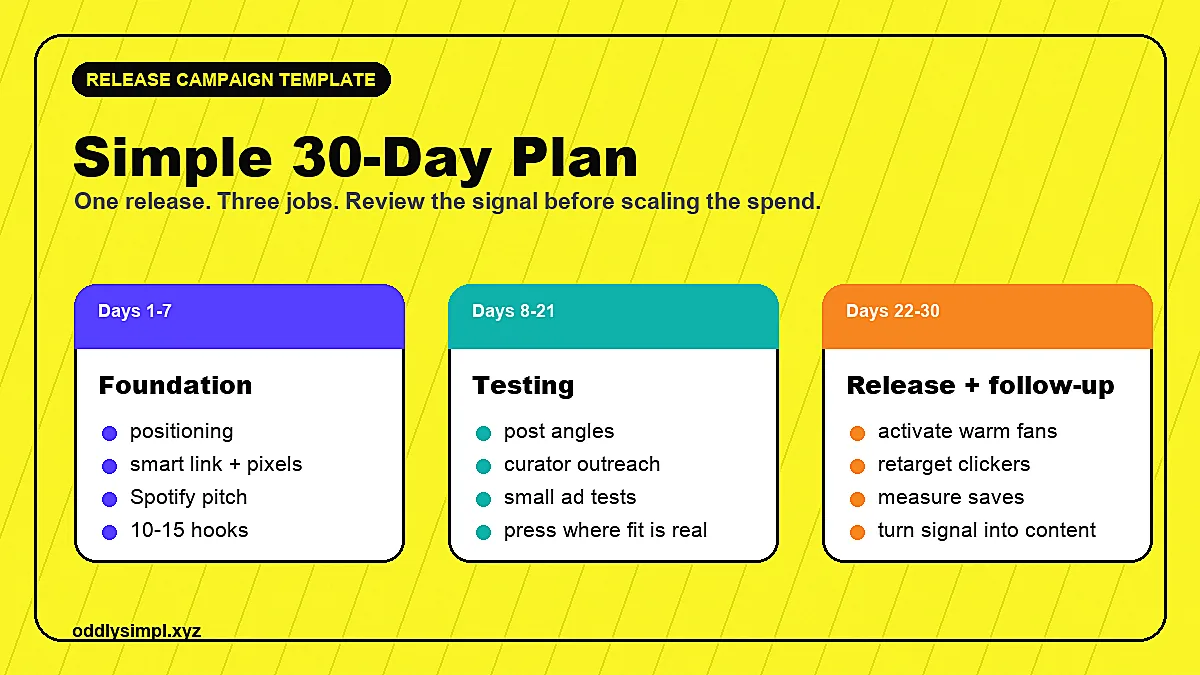
Days 1-7: Foundation
- Define the audience and positioning.
- Set up the smart link, pixels, email capture, and Spotify pitch.
- Build 10-15 content ideas around the song's strongest angles.
Days 8-21: Testing
- Post multiple content angles.
- Start curator and press outreach where the fit is real.
- Test small ad audiences if you have a clear creative hypothesis.
Days 22-30: Release and Follow-Up
- Activate warm fans on release day.
- Retarget engaged viewers and clickers.
- Watch saves, follows, source of streams, and repeat listening.
- Turn the best-performing angle into the next week of content.
This is the work. Not glamorous. Very useful.
Music Marketing Strategy FAQ
What are music marketing strategies?
Music marketing strategies are the planned ways artists connect songs with the right listeners: positioning, short-form content, Spotify pitching, playlist outreach, ads, PR, email, live shows, and analytics.
What is music marketing?
Music marketing is the system artists use to connect songs with the right listeners through positioning, content, Spotify, playlists, ads, press, live shows, fan capture, and measurement.
What is the best music marketing strategy for independent artists?
The best music marketing strategy is a repeatable release system: define the audience, create content around the song, drive qualified listeners, measure saves and follows, and use the results to make the next release stronger.
How do you promote your music independently?
Promote music independently by building a clear artist story, posting content that gives the song context, pitching Spotify and curators where the fit is real, using smart links, collecting fan data, and testing small ad campaigns when you have a strong hook.
How much should artists spend on music marketing?
Spend enough to learn from the campaign without risking the whole release. Early artists can start with a few hundred dollars in controlled testing, while larger campaigns should scale only after the content, audience, and listener data are working.
If you want help building the campaign around real listener behavior, work with simpl. We help independent artists connect content, ads, analytics, and release strategy so growth does not reset after every drop.
Keep building the strategy
-
Music marketing agency for independent artists
See how simpl. turns the strategy into paid tests, listener data, and a plan for the next release.
-
Music marketing companies
Compare agency types before hiring help for your next campaign.
-
Music release strategy
Turn the marketing plan into a release-week and post-release system.
About the author

Anthony Pacheco
Anthony Pacheco is the founder of simpl., a former Sony Music analyst, and a Billboard-charting musician who has helped run 750+ artist marketing campaigns. He writes about real listener behavior, release systems, Spotify ads, and how artists can grow without fake playlist traffic.