TikTok · Updated July 3, 2026
TikTok Music Promotion: Turn Views Into Real Fans
TikTok music promotion works when a song moment gives people something to do: quote the lyric, argue in the comments, use the sound, send it to a friend, or click through because the artist feels worth following.
The weak version is posting random clips and hoping the platform does charity. The useful version is a repeatable test around hooks, song sections, creator prompts, comments, hashtags, profile setup, and a path from the video to Spotify, YouTube, email, merch, or tickets.
TikTok Music Promotion Starts With the Song Moment
Songs spread on TikTok when a short part of the track becomes useful to creators and clear to viewers. The song moment needs a reason to exist in a video: a lyric people can quote, a feeling people recognize, a gesture people can repeat, a joke format, a transformation, a story, or a visual world that makes the sound easy to use.
No one can guarantee a viral TikTok campaign. You can improve the odds by testing the right 10 to 20 seconds of the song, giving viewers context before the hook, making the sound easy to reuse, and measuring whether the attention turns into real listener action.
How to Make a Song Go Viral on TikTok Without Chasing Luck
Before you promote a song on TikTok, choose the song moment that has the best chance of spreading. Do not assume it is the chorus. Sometimes the strongest TikTok moment is one lyric, one vocal run, one beat switch, one guitar part, or one awkwardly honest line that makes people comment.
| Song moment | Best content angle | What to measure |
|---|---|---|
| Specific lyric | "This line is for anyone who..." | Comments quoting the lyric |
| Big chorus | Performance, transition, or creator challenge | Replays, shares, sound uses |
| Emotional verse | Story behind the song | Saves, follows, profile visits |
| Beat drop or switch | Edit, dance, outfit, gym, travel, or visual transformation | Completion rate and sound reuse |
| Funny or weird detail | Comment bait, stitch prompt, or reaction format | Comments and stitches |
The Hook-Song-Action Framework
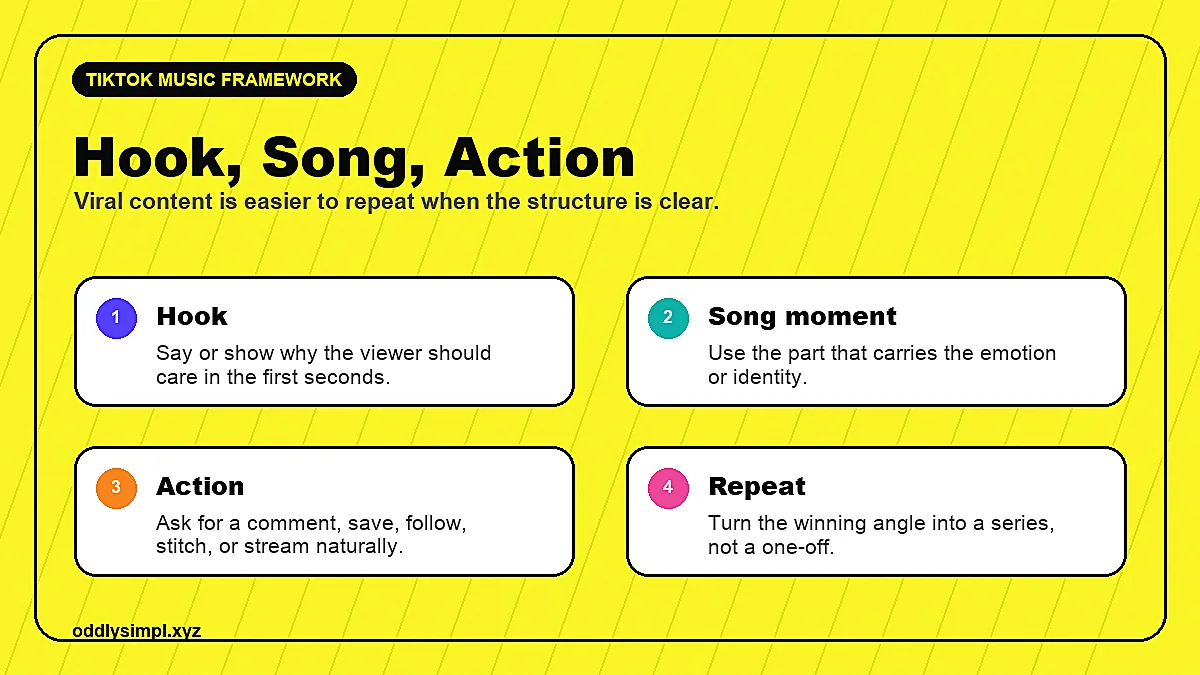
The best TikTok music videos do three jobs in order:
- Hook: give the right viewer a reason to stop. This can be text on screen, a visual reveal, a direct question, or a specific emotional statement.
- Song moment: play the part of the track that proves the hook. Start where the feeling is obvious, not automatically at second zero.
- Action: ask for one next step: comment, follow, use the sound, stream, save, join the list, or watch the next clip.
Artists get better results when they treat TikTok as a context machine, not a miniature music video platform. The viewer needs to know why the song belongs in their life before they decide whether the song is good.
TikTok Music Promotion Ideas That Are Reusable
- The lyric callout: "I wrote this line for anyone who..." Then let the lyric do the work.
- The similar-artist bridge: "If you like [artist] but wish it had more [feeling], try this." Keep the comparison honest.
- The story receipt: show the text, place, voice memo, photo, or moment that made the song real.
- The process clip: show the demo, vocal stack, guitar tone, drum pattern, or mix change.
- The comment reply: answer one useful comment with another video using the song.
- The creator prompt: give people a reason to use the sound: "use this for the person you miss but will not text."
- The live proof: post a stripped-down vocal, rehearsal, show clip, or one-take performance.
- The fan interpretation: ask listeners what lyric, color, character, movie scene, city, or memory the song feels like.
For a deeper bank of repeatable formats, use the TikTok content template for musicians.
Best hashtags for TikTok music promotion
Hashtags can help TikTok understand context, but they will not rescue weak content. Use 3 to 6 specific tags instead of stuffing every post with giant tags like #fyp and #viral.
A simple hashtag mix:
- 1 artist tag: #indieartist, #newartist, #singersongwriter, #rapper, #band, or your genre equivalent
- 1 genre or mood tag: #indiepop, #altrock, #countrymusic, #sadmusic, #breakupsong, #gymmusic
- 1 use-case tag: #newsong, #originalsong, #songwriter, #musicdiscovery, #newmusic
- 1 campaign tag: your artist name, song title, lyric phrase, or fan-community tag
The real test is not whether the hashtag looks clever. It is whether the post reaches people who save, follow, comment with recognition, or click through to the music.
Free ways to promote a song on TikTok
Free TikTok music promotion is mostly a labor trade. You spend time testing angles before you spend money forcing distribution.
- Post 9 to 15 clips for the same song across lyric, story, performance, and process angles.
- Reply to every useful comment with a new video.
- Pin the strongest clip and make the profile link point to one clean destination.
- Use the same winning clip idea on Reels and Shorts.
- Ask 10 to 25 small creators, friends, fans, or scene peers to use the sound with a specific prompt.
- Track which clip creates saves, follows, link clicks, and repeat listens, not only views.
TikTok creator campaigns and promotion services
Creator campaigns can work when the creator's audience fits the song. Follower count is not enough. A small creator with the right taste, humor, scene, or emotional lane can outperform a bigger account using the song like wallpaper.
Be careful with TikTok music promotion services that promise guaranteed viral sounds, guaranteed streams, or cheap packages with no audience logic. A useful service should explain creator fit, content brief, tracking, rights, timing, and what happens after the first clips go live.
Reddit-style skepticism is healthy here. If the offer sounds like "pay us and the algorithm will obey," pass. If the offer sounds like "we will test creators, angles, and listener behavior so the campaign teaches you something," that is closer to a real system.
When to use TikTok ads for music promotion
TikTok ads are best after organic testing shows a clip or content angle has life. Paid spend can help scale a signal. It is much worse at manufacturing one from nothing.
Use ads when you have:
- a clip with strong watch time or comments
- a clear listener profile
- a song section that makes sense in short-form video
- a landing path that can track streams, saves, follows, or signups
- a follow-up content plan after the paid push
What to measure after a TikTok spike
A viral TikTok means very little if it does not create downstream movement. Watch the music data after each content spike:
- Spotify saves, follows, playlist adds, and repeat listeners
- smart-link clicks and destination choices
- YouTube searches or video views for the song title
- email, SMS, Discord, merch, or ticket actions
- cities and countries that over-index after the post
- comment language that reveals who the song is for
The music analytics guide explains how to read those signals without getting hypnotized by one big number.
TikTok Music Promotion FAQ
How do you make a song go viral on TikTok?
You cannot guarantee a song will go viral on TikTok, but you can improve the odds by testing the strongest 10-20 seconds, giving viewers context, making the sound easy to reuse, and tracking whether attention turns into saves, follows, streams, or creator uses.
How do artists promote music on TikTok?
Artists promote music on TikTok by posting repeatable lyric, story, performance, process, and creator-prompt videos, then measuring profile visits, smart-link clicks, saves, follows, sound uses, and comments that show recognition.
Do hashtags make songs go viral on TikTok?
Hashtags help TikTok understand the context of a post, but they do not make weak content go viral. Use a few specific genre, mood, artist, and campaign tags instead of stuffing every post with broad viral tags.
Should musicians pay for TikTok promotion?
Paid TikTok promotion can help after an organic clip or creator angle shows promise. It is risky when a service promises guaranteed viral sounds, guaranteed streams, or cheap traffic with no audience logic.
The real goal
Going viral is useful when it reveals demand. It is dangerous when it becomes the whole identity of the campaign.
The better question is: what did the viral attempt teach you? Which lyric made strangers care? Which creator audience understood the song? Which clip moved people to Spotify? Which city showed up? Which comment gave you the next piece of creative?
That is the part most artists skip. They chase the next spike instead of turning the last signal into a better release strategy. If you want help building that system, work with simpl. We help artists test content, ads, and listener behavior without pretending one viral clip is the whole career.
Keep building the strategy
-
TikTok for musicians
Turn short-form attention into saves, follows, repeat listens, and real fan actions.
-
TikTok content template
Use repeatable video frameworks instead of guessing what to post next.
-
Music analytics
Connect TikTok views to Spotify saves, follows, and listener quality.
About the author

Anthony Pacheco
Anthony Pacheco is the founder of simpl., a former Sony Music analyst, and a Billboard-charting musician who has helped run 750+ artist marketing campaigns. He writes about real listener behavior, release systems, Spotify ads, and how artists can grow without fake playlist traffic.