Spotify · Updated July 3, 2026
Spotify Promotion Services: Legit Options and Red Flags
Most Spotify promotion services sell artists the same dream: more streams, more playlist adds, more momentum.
The missing word is quality.
If a campaign gives you 20,000 plays and zero saves, zero follows, zero repeat listeners, and no useful audience data, you did not build momentum. You rented a number on a dashboard.
Quick answer: Spotify promotion is legit when it reaches real listeners through transparent channels and gives you data you can use on the next release. It is risky when it sells guaranteed streams, mystery playlists, suspiciously cheap volume, or reports that never show saves, follows, source quality, or repeat listening.
The difference shows up after the spike. Legit Spotify promotion leaves you with saves, followers, repeat listeners, or audience data you can use again. Risky promotion leaves you with a screenshot and questions about where the streams came from.
Are Spotify Promotion Services Legit?
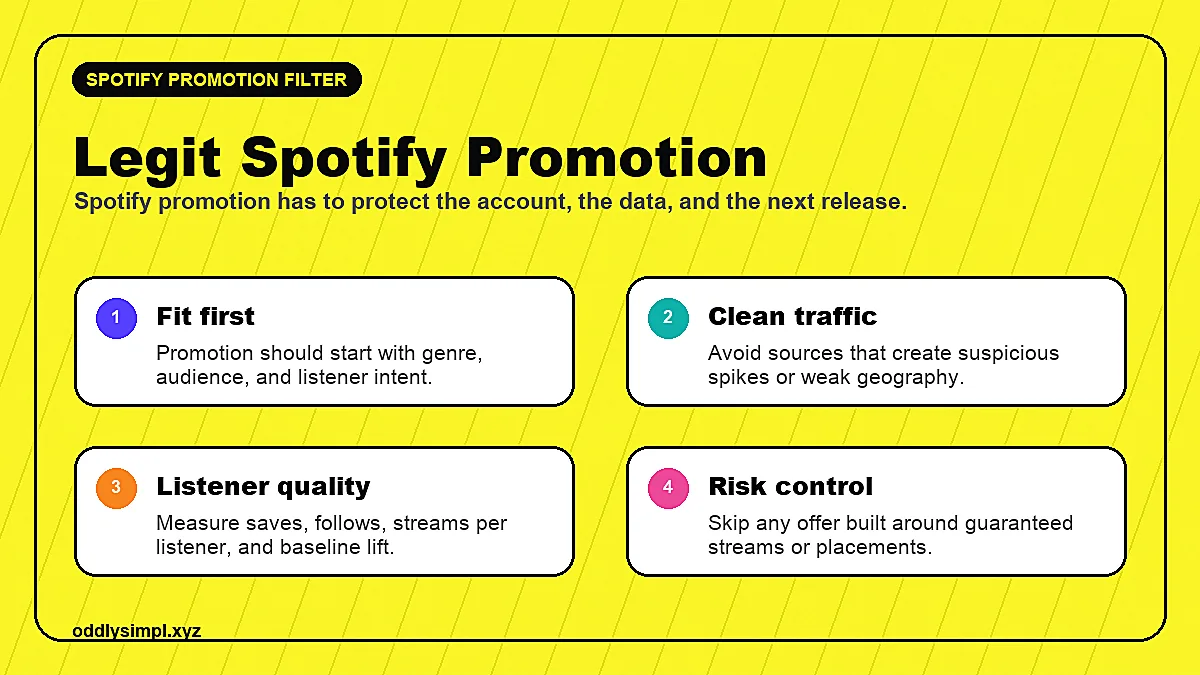
Some Spotify promotion services are legit. A legit service can explain where the listeners come from, what method is being used, what metrics you will see, and why the campaign should help your artist profile long term.
The risky ones usually sell certainty where certainty does not exist. Guaranteed streams, guaranteed playlist placements, suspiciously cheap packages, and vague "organic promotion" language are the danger zone.
So the better question is not "is Spotify promotion legit?" It is: what kind of promotion is this, and does it create real listener behavior?
Is Spotify Promotion Worth It?
Spotify promotion is worth it when it teaches you something useful or creates real fan actions: saves, follows, repeat listening, personal playlist adds, better source-of-streams data, email signups, or a clearer audience lane.
It is not worth it when the only result is a temporary stream spike from listeners who never come back.
If you are early, the best promotion may be a smaller test that helps you learn which song, audience, or creative angle is working. If you already have traction, promotion can help scale the release without guessing. Either way, the goal is listener quality, not a prettier graph.
What Reddit Gets Right About Spotify Promotion Services
Reddit threads about Spotify promotion services are usually skeptical for a reason. A lot of artists have paid for campaigns that promised organic growth and delivered streams with no saves, no follows, no audience clarity, and no explanation of where the traffic came from.
That skepticism is useful. Read Reddit-style feedback for patterns:
- Did artists get source transparency?
- Did saves, follows, and repeat listeners move with the streams?
- Did the service guarantee numbers?
- Did the audience countries and similar artists make sense?
- Did anything remain after the campaign ended?
Do not treat every angry comment as proof that all promotion is bad. Treat the repeated complaints as a checklist for what to avoid.
What Spotify Promotion Should Do
Good Spotify promotion means getting streams from listeners who behave like potential fans.
It helps you answer a better question: who responds to this song, and how do we reach more people like them?
A real campaign should create at least one of these outcomes:
- Listener quality: people save the song, follow the artist, add it to personal playlists, or come back again.
- Audience learning: you learn which countries, cities, age groups, artists, scenes, or creative angles respond best.
- Content feedback: you learn which hooks, clips, visuals, or stories make people care before they hear the full song.
- Algorithmic signal: Spotify sees real listening behavior from people who finish, save, and revisit the song.
- Owned audience growth: you collect emails, retargeting audiences, or social followers you can reach again.
If a service cannot explain how it creates those outcomes, it is probably selling volume instead of growth.
The Main Types of Spotify Promotion Services
Not every service is the same. The category matters because each one creates a different kind of result.
1. Playlist Pitching Services
Playlist pitching services submit your song to independent curators. The best version of this is simple: curators listen, decide if the song fits, and add it only if they like it.
The upside is discovery. A good independent playlist can put your song in front of listeners who already like your genre.
The downside is passivity. Playlist listeners are often doing something else: driving, studying, working out, cleaning. They may like the vibe without ever remembering your name. If the playlist is too broad or too passive, you get streams without relationship.
Playlist pitching is not automatically bad. But it should be one layer, not the whole strategy.
2. Playlist Marketplace Platforms
Marketplace-style platforms connect artists with curators at scale. This can be useful when there is transparency, genre fit, and no guaranteed placement.
The risk is that artists start treating playlist consideration like paid distribution. "I paid, therefore I should get streams." That mindset leads to chasing placement instead of building demand.
If you use a marketplace, judge it by save rate, follower growth, listener retention, and whether the playlists make sense for your sound. Do not judge it by stream count alone.
If you are comparing marketplace tools, start with the Playlist Push alternatives guide so you can match the tool to the job instead of buying the loudest promise. If you want the submission workflow first, read the Spotify playlist submission guide.
3. Paid Ads to Spotify
Paid ads are usually the cleanest way to test demand because you control the targeting, the creative, the landing page, and the data.
A good Spotify ad campaign starts with specific audience ideas: fans of similar artists, scenes, moods, cultures, and content angles. Then it tests which combination produces the best listener behavior.
This is where Spotify promotion becomes useful long term. Even if the first campaign is imperfect, you learn something. You learn which hooks convert, which audiences care, and where the song has oxygen.
That data makes the next release smarter.
4. PR and Blog Campaigns
PR can help when your song, story, or project has a real angle. It is useful for credibility, search visibility, and social proof.
But PR is not the same as fan growth. A blog placement can look great and still send very little listening activity. Use PR when there is a story worth telling, not as a replacement for content, ads, and direct fan-building.
5. Submission Tools
Submission tools can help you organize outreach to curators, blogs, influencers, and radio. They are useful when you treat them like workflow software.
They are not magic. The pitch still matters. The song still matters. The fit still matters.
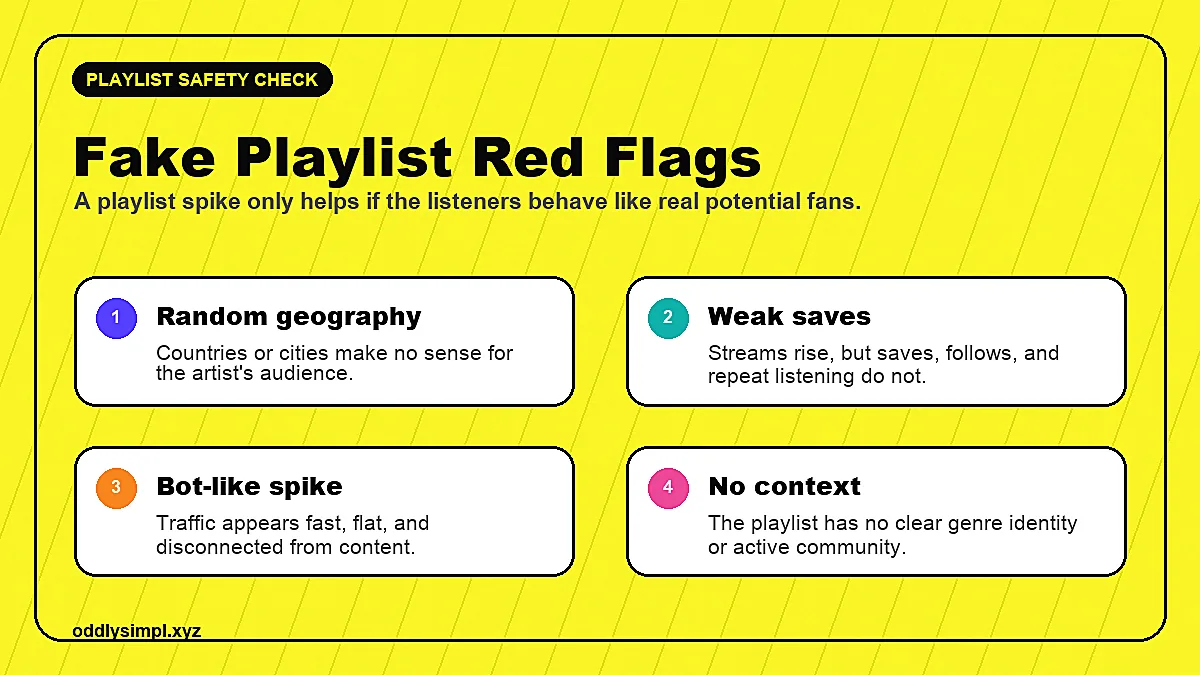
Red Flags: When a Spotify Promotion Service Is Risky
There are a few warning signs that should make you slow down immediately.
- Guaranteed streams: nobody can honestly guarantee real listener behavior at a fixed number.
- Guaranteed playlist placements: real curators choose songs because they fit, not because a package promised it.
- Suspiciously cheap volume: if the price makes no sense, the traffic probably does not either.
- No source transparency: you should know whether streams came from ads, playlists, countries, curators, or other channels.
- No reporting beyond streams: saves, followers, listener retention, geography, and source quality matter more.
- They avoid talking about bots: any legit service should be comfortable explaining how they avoid fake activity.
- They sell the same package to every artist: your song, genre, budget, and stage should change the strategy.
The biggest red flag is when the service makes you feel like you can skip the hard part: creating reasons for people to care.
You cannot outsource that. Promotion can amplify demand. It cannot fake demand forever.
What Metrics Matter?
Streams matter, but they are incomplete.
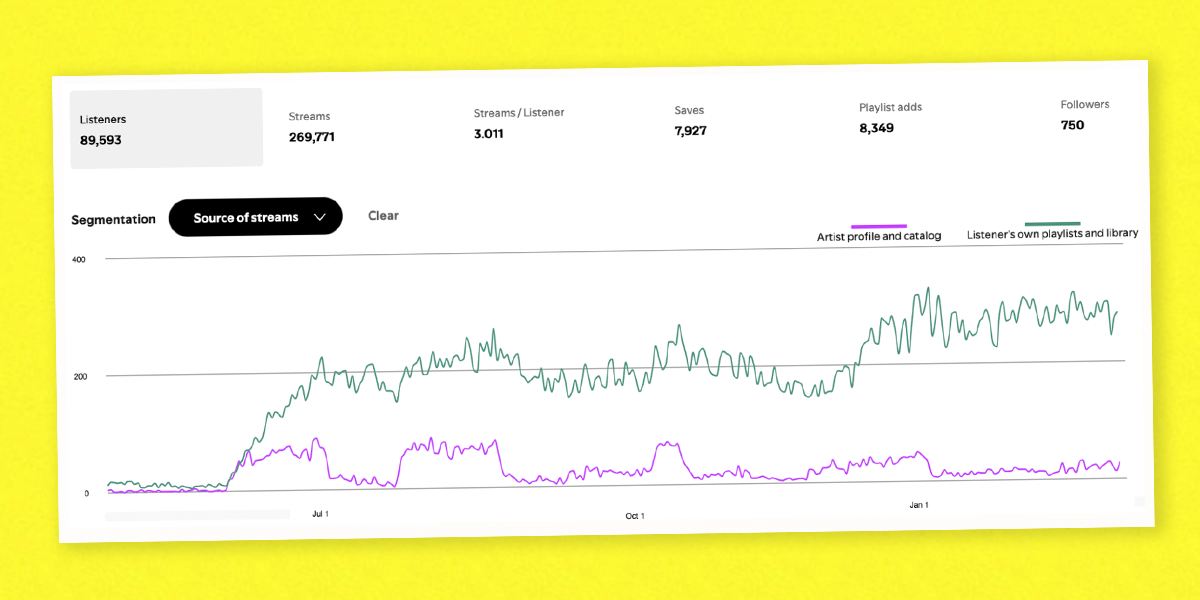
When you evaluate a Spotify campaign, look for signals that listeners are behaving like potential fans:
- Save rate: are people saving the song after hearing it?
- Follower growth: are listeners interested enough to follow the artist?
- Streams per listener: are people replaying, or is it one-and-done traffic?
- Playlist adds: are listeners adding the song to their own playlists?
- Source of streams: are streams coming from algorithmic, active, or suspicious sources?
- Country and city quality: are the markets relevant to your actual audience and touring/content strategy?
- Post-campaign baseline: does anything remain after the spend or placement ends?
The best campaigns leave residue. Maybe daily streams settle higher. Maybe you know your best-performing audience. Maybe your Spotify Fans Also Like starts making more sense. Maybe you have retargeting data for the next release.
If everything disappears the second the campaign stops, you bought a temporary chart line, not a system.
Playlist Promotion vs Spotify Ads
Playlist promotion and Spotify ads solve different problems.
Playlist promotion can be useful when you want passive discovery from listeners already inside a mood or genre. It works best when the playlist has real followers, a tight sound, and listeners who engage.
Spotify ads are better when you want control and learning. You can test audiences, test creative, control spend, and build data around who responds.
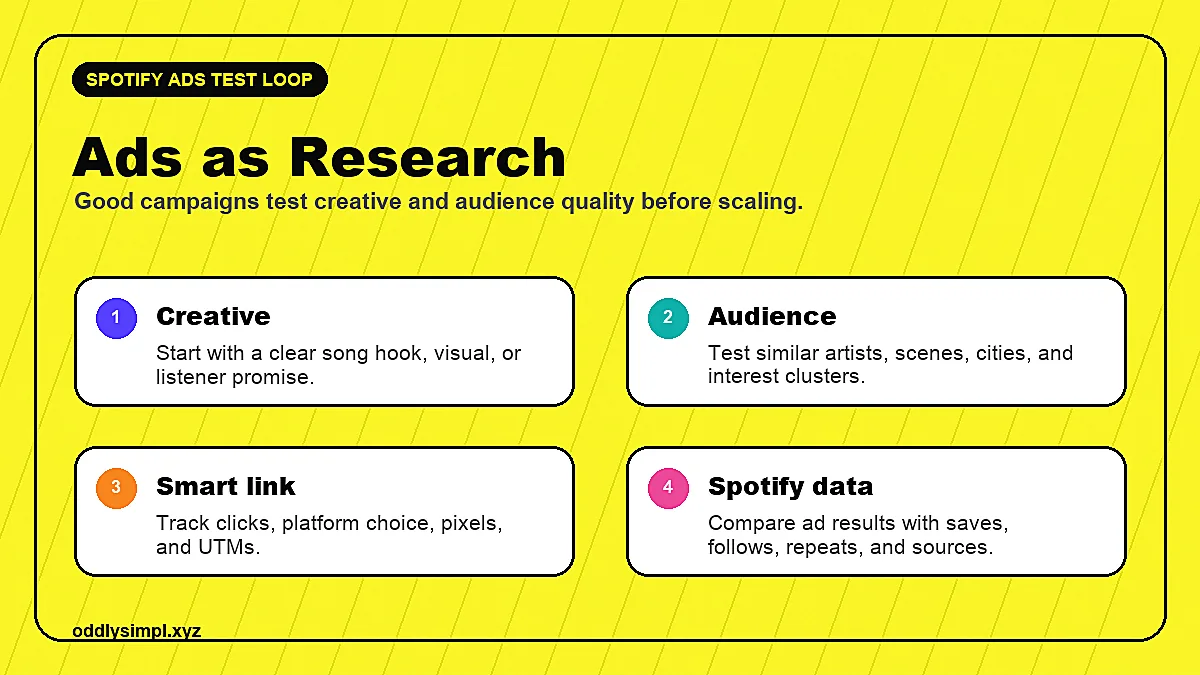
For most independent artists, the strongest strategy is not "playlist or ads." It is a system:
- Content gives the song context.
- Ads test which context and audience converts.
- Smart links show where listeners click and which platform they choose.
- Spotify analytics show listener quality.
- Playlist pitching adds extra discovery when the fit is real.
That is a healthier model than hoping one playlist saves the release.
How Much Should Independent Artists Spend?
There is no universal number, but there is a useful rule: spend enough to learn something, not so much that one bad test wrecks your release.
If you are early, a few hundred dollars in controlled testing can be more valuable than a large playlist package because you come away with audience data. If you already have traction, a larger campaign can scale what is already working.
The budget should match the stage of the artist:
- New artist: test content angles and find the first pockets of real listener response.
- Growing artist: scale the strongest audience segments and build repeat listeners.
- Established independent artist: coordinate ads, content, playlist pitching, PR, email, retargeting, and release timing.
Do not spend to look bigger than you are. Spend to learn faster and compound cleaner.
A Simple Vetting Checklist
Before hiring any Spotify promotion service, ask these questions:
- Where exactly will the listeners come from?
- Can you explain the campaign method without vague language?
- Do you guarantee streams or placements?
- What metrics will I see besides total streams?
- How do you avoid fake playlists, bots, and low-quality traffic?
- What happens after the campaign ends?
- How does this support my next release?
A serious partner will answer plainly. A risky service will dodge, overpromise, or make the whole thing sound too easy.
What Works in 2026
The artists winning now are not chasing one magic lever.
They are building a repeatable loop:
- Release music consistently enough to give the algorithm and fans new signals.
- Create short-form content that gives people a reason to care before they stream.
- Use smart links and pixels so every click teaches you something.
- Run targeted ads to test audiences and scale the strongest creative.
- Study Spotify for Artists to see whether listeners are saving, following, and returning.
- Use playlist pitching carefully, only where the fit is real.
- Turn the learnings into the next release plan.
That is less sexy than a guaranteed-stream package. It also works better.
When simpl. Is a Fit
simpl. is not for artists who want fake activity, guaranteed streams, or a quick vanity spike.
It is for artists who want to understand who their music is for and build campaigns around real listener behavior. We focus on Spotify ads, audience testing, creative strategy, and the data that helps each release compound into the next one.
If you are trying to figure out whether your bottleneck is audience fit, creative, release strategy, or paid growth, start with the Spotify ads page.
And if you are still learning the Spotify ecosystem, read the guides on Spotify algorithmic playlists, Spotify playlists, music analytics, and smart links for music.
The goal is not to make the graph look exciting for a week.
The goal is to build a system that still matters after the campaign ends.
Keep building the strategy
-
Playlist Push alternatives
Compare playlist tools, submission platforms, ads, and full campaign strategy.
-
Spotify ads for artists
Build campaigns around real listener behavior instead of fake playlist traffic.
-
Spotify algorithmic playlists
Learn which listener signals help Spotify recommend your songs.
About the author

Anthony Pacheco
Anthony Pacheco is the founder of simpl., a former Sony Music analyst, and a Billboard-charting musician who has helped run 750+ artist marketing campaigns. He writes about real listener behavior, release systems, Spotify ads, and how artists can grow without fake playlist traffic.