TikTok · Updated July 3, 2026
TikTok Content Template for Musicians: 9 Video Ideas

Most artists do not have a creativity problem. They have a blank-page problem. They open TikTok, stare at the camera, decide every idea feels cringe, and post nothing.
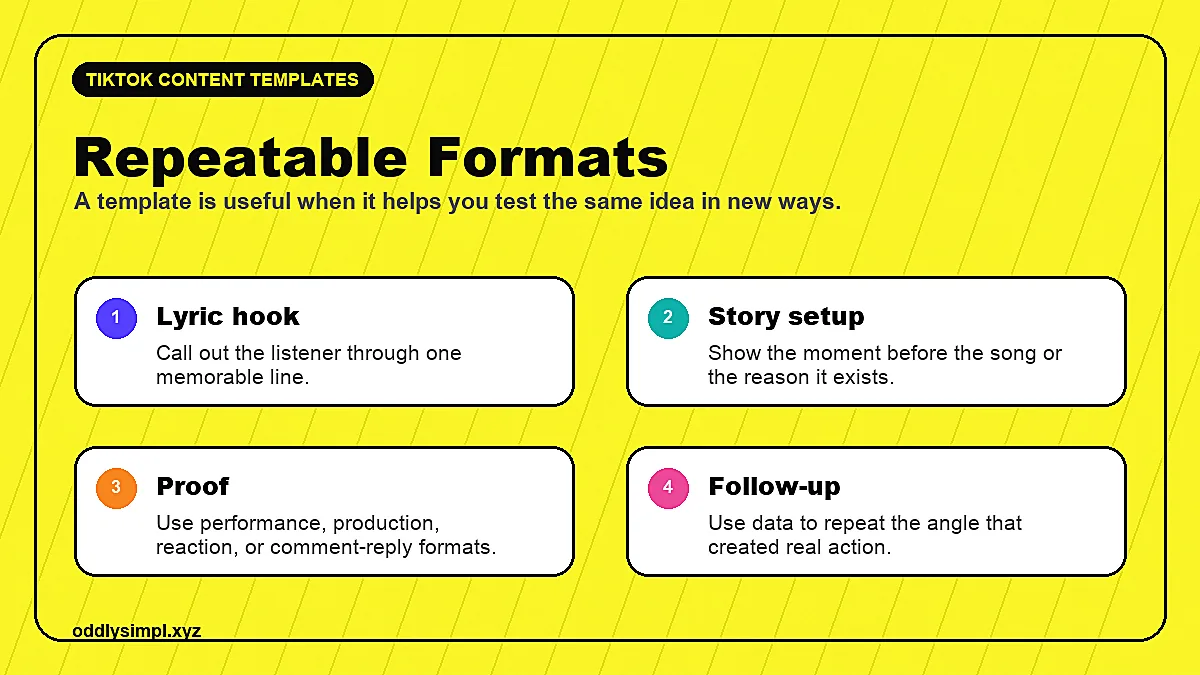
A TikTok content template fixes that. Not because it makes you robotic, but because it gives every song a few repeatable angles: the lyric, the story, the performance, the process, the fan reaction, and the reason a stranger should care.
TikTok has also become more search-driven. Creator Search Insights, TikTok Studio, and TikTok's newer creative tools all point in the same direction: the platform rewards content that is clear, original, watchable, and aligned with what people are already trying to discover. For musicians, that means your clips need more than "new song out now."
The simple TikTok template
Use this structure for almost every music video:
- Hook: one sentence or visual that tells the right viewer why this matters.
- Context: the feeling, story, comparison, problem, or moment around the song.
- Song moment: the section that best proves the hook.
- Next step: ask for the comment, follow, save, stream, duet, stitch, or profile visit.
The mistake is starting with the song and hoping people care. Give them a reason to care first.
How to use these TikTok content ideas for musicians
Do not treat this like a list of one-off prompts. Pick one song and run several ideas against the same hook, lyric, or story. That is how you learn whether the issue is the song moment, the packaging, the audience, or the way you are asking people to respond.
A simple test for one week:
- Post one lyric angle for the listener who needs the song.
- Post one story angle that explains where the song came from.
- Post one performance clip that proves the vocal, riff, beat, or chorus works.
- Post one process clip that makes the song feel less anonymous.
- Post one follow-up based on the best comment or strongest profile-visit signal.
If none of the five creates useful signal, change the hook before blaming TikTok. If one angle creates comments, saves, or profile visits, make more versions before moving to a new idea.
1. The lyric that calls someone out
Template: "This lyric is for anyone who [specific situation]." Then show the lyric on screen and let the line hit.
Examples:
- "This lyric is for anyone who stayed too long because they were scared to start over."
- "I wrote this for the friend who acts fine and then disappears for three weeks."
- "If you have ever romanticized someone who was terrible for you, this part is yours."
Best metric: comments where people quote the lyric or tell their own version of the story.
2. The story before the song
Template: "I wrote this song after..." Tell the short version, then play the section that makes the story feel true.
Keep it human. You do not need a trauma monologue. You need one clear emotional frame: who it was about, what changed, what you realized, or what the song helped you say.
3. The similar-artist bridge
Template: "If you like [artist A] and [artist B], this might make sense." Then show the strongest 10-20 seconds.
This works because it gives TikTok and the viewer a fast positioning shortcut. Do not name artists you sound nothing like. The goal is not clout by association. The goal is to find the listener who already has a context for your sound.
4. The making-of clip
Template: show the demo, the vocal stack, the guitar tone, the drum programming, the first voice memo, or the mix change that made the song click.
Process content works because it lets people participate before the song is finished. It also gives you content before release day, when most artists are weirdly silent.
5. The comment reply
Template: find a real comment and answer it with a new video. The answer can be a performance, explanation, story, joke, tutorial, or a different part of the song.
Do not wait for huge comment volume. One useful comment can become five posts if it reveals what people are curious about.
6. The performance proof
Template: raw vocal, acoustic version, rehearsal clip, live clip, or one-take performance with a simple text hook.
People still want proof that the artist can deliver. A polished edit is useful, but sometimes a rough performance does more because it makes the song feel alive.
7. The world around the song
Template: show the room, city, clothes, references, visuals, books, films, or memories that belong to the song.
This is how artists build taste. The song is the product, but the world around the song is what makes people remember you.
8. The fan action prompt
Template: "Use this sound for..." or "send this to..." or "comment the lyric you needed today."
This works best when the prompt is emotionally specific. "Use my sound" is too vague. "Use this for the person you miss but would never text again" gives people a reason.
9. The data-backed follow-up
Template: take the clip that produced saves, comments, or profile visits and make three more versions from the same angle.
Do not abandon an angle after one post. If the lyric angle worked, try the demo version, the live version, the story version, and the similar-artist version.
A weekly TikTok content plan for musicians
- Monday: lyric hook
- Tuesday: story behind the song
- Wednesday: making-of or demo clip
- Thursday: performance proof
- Friday: release or streaming CTA
- Saturday: comment reply
- Sunday: recap what worked and turn the best angle into next week's posts
What to track
Views are the easiest number to obsess over and the easiest number to misunderstand. Track the signals that tell you whether a clip is creating real listener intent:
- average watch time and completion rate
- profile visits
- comments that reference the song, lyric, or story
- follows after a post
- link clicks
- Spotify saves, follows, and repeat listening after content spikes
TikTok Content Template FAQ
What should musicians post on TikTok?
Musicians should post lyric hooks, short stories behind songs, similar-artist bridges, making-of clips, comment replies, raw performances, visual-world posts, fan prompts, and follow-up versions of the clips that already created saves or profile visits.
How do you promote your music on TikTok?
Promote music on TikTok by giving viewers context before the song moment. Start with a specific hook, explain why the song matters, play the strongest section, and ask for one action like a comment, follow, save, stream, duet, or profile visit.
How many TikToks should musicians post per week?
A useful starting point is 3-5 posts per week, but the key is testing different angles instead of repeating the same out-now clip. One song can support lyric, story, performance, process, fan, and similar-artist formats.
How do musicians know if a TikTok worked?
A TikTok worked if it created listener intent: profile visits, comments about the song, follows, link clicks, saves, Spotify follows, repeat listening, or useful audience data you can build the next post around.
Pair this page with the full guide on using TikTok to grow a real music fanbase and the music analytics guide so you can connect content to actual listener behavior.
If you want the campaign built around the content that is already getting signal, work with simpl. We help artists turn short-form attention into Spotify saves, follows, ads, retargeting pools, and release strategy that does not reset every time.
Keep building the strategy
-
TikTok for musicians
Build the full TikTok fan-growth system around the content templates.
-
Music analytics
Measure which TikTok angles create real listener behavior.
-
Music marketing strategies
Fit TikTok into release planning, ads, and long-term fan growth.
About the author

Anthony Pacheco
Anthony Pacheco is the founder of simpl., a former Sony Music analyst, and a Billboard-charting musician who has helped run 750+ artist marketing campaigns. He writes about real listener behavior, release systems, Spotify ads, and how artists can grow without fake playlist traffic.