Spotify · Updated July 10, 2026
Playlist Push Alternatives: Sites Like Playlist Push
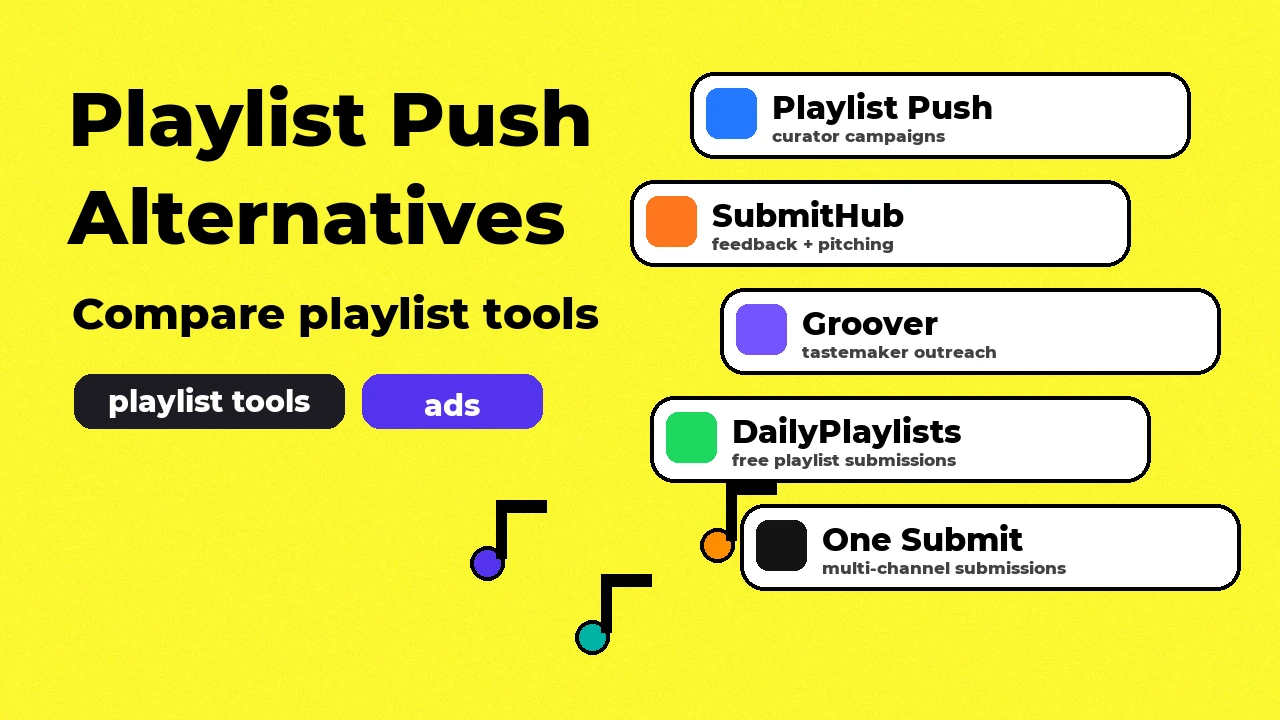
Playlist Push can be useful. It is one of the better-known playlist pitching platforms for independent artists, and it can make sense when your song is strong, the genre fit is clear, and you want curator consideration from people who already run Spotify playlists.
It is also one tool. It is not a full music marketing strategy.
The biggest mistake is asking, "What is the best Playlist Push alternative?" before asking, "What problem am I trying to solve with this release?"
If you need playlist feedback, use a submission tool. If you need listener data, use ads and analytics. If you need social proof, use PR. If you need a release system, build the campaign around content, smart links, retargeting, and Spotify listener quality.
The comparison below separates curator feedback, playlist pitching, ads, PR, and release strategy so you do not buy one service expecting it to do another service's job.
Quick Answer: The Best Playlist Push Alternative Depends on the Goal
- Best for curator feedback: SubmitHub or Groover.
- Best free playlist submission starting point: DailyPlaylists.
- Best broader submission marketplace: One Submit.
- Best for controlled audience testing: Spotify-focused Meta ads with smart links and clean tracking.
- Best for release strategy: a campaign system that combines content, ads, analytics, playlist pitching, and follow-up.
Playlist Push sits mainly in the independent curator lane. That can help with discovery, but it does not replace a full music release strategy.
Sites Like Playlist Push: Quick Comparison
Most sites like Playlist Push help artists get music in front of curators. The difference is how much control, feedback, and useful data you get after the pitch.
| Platform | Best use | What to watch |
|---|---|---|
| Playlist Push | Paid Spotify curator pitching when the song has obvious playlist fit. | Judge the campaign by saves, follows, repeat listening, and playlist quality. |
| SubmitHub | Affordable feedback, blogs, curators, and targeted tastemaker pitching. | Rejections are part of the value if you use the feedback. |
| Groover | Curators, media, labels, radio, and niche scene outreach. | Works better when the song has a clear story or scene fit. |
| DailyPlaylists | Free or low-cost playlist submission research. | You still need to filter for real playlists and genre fit. |
| One Submit | Spotify, TikTok, YouTube, blogs, online radio, and label submissions. | More channels only help if you can track what came back. |
If you are searching for websites like Playlist Push, do not stop at the platform list. Pick the tool based on the job: feedback, playlist access, social creator reach, or audience testing.
What Playlist Push Is Good For
Playlist Push pitches music to independent curators. That is useful when the song has a clear playlist fit and the artist wants to reach listeners who already use Spotify playlists for discovery.
The benefit is access. You do not have to manually find every curator, organize every pitch, and follow up one by one.
The limitation is control. You cannot force a curator to like the song, and you cannot assume playlist listeners will become fans. A placement can create streams without creating saves, follows, repeat listeners, or audience clarity.
That does not make Playlist Push bad. Judge it by the right metrics.
Playlist Push vs SubmitHub vs Groover
Playlist Push is the most playlist-specific option in this comparison. SubmitHub and Groover are broader feedback and tastemaker tools.
Use Playlist Push when the song already sounds right for playlist discovery and you want curator consideration at scale. Use SubmitHub when you want cheaper feedback and a wider mix of blogs, curators, and influencers. Use Groover when you want a similar pitching workflow with more emphasis on media, radio, labels, and scene-specific tastemakers.
The practical difference: Playlist Push can make sense for a polished, playlist-ready track. SubmitHub and Groover can help you learn why people respond or pass. That feedback is useful before you spend more money on ads, PR, or playlist promotion.
When You Should Look for an Alternative
Look beyond Playlist Push if:
- you want detailed feedback before you spend heavily on promotion
- your budget is small and you need cheaper testing
- you want to choose specific curators or outlets yourself
- you need TikTok, blog, YouTube, or radio submissions too
- you want ad data beyond playlist consideration
- you are trying to build a repeatable release system instead of one campaign spike
The right alternative is the one that makes the next release easier to plan.
Playlist Push Alternatives Compared
1. SubmitHub
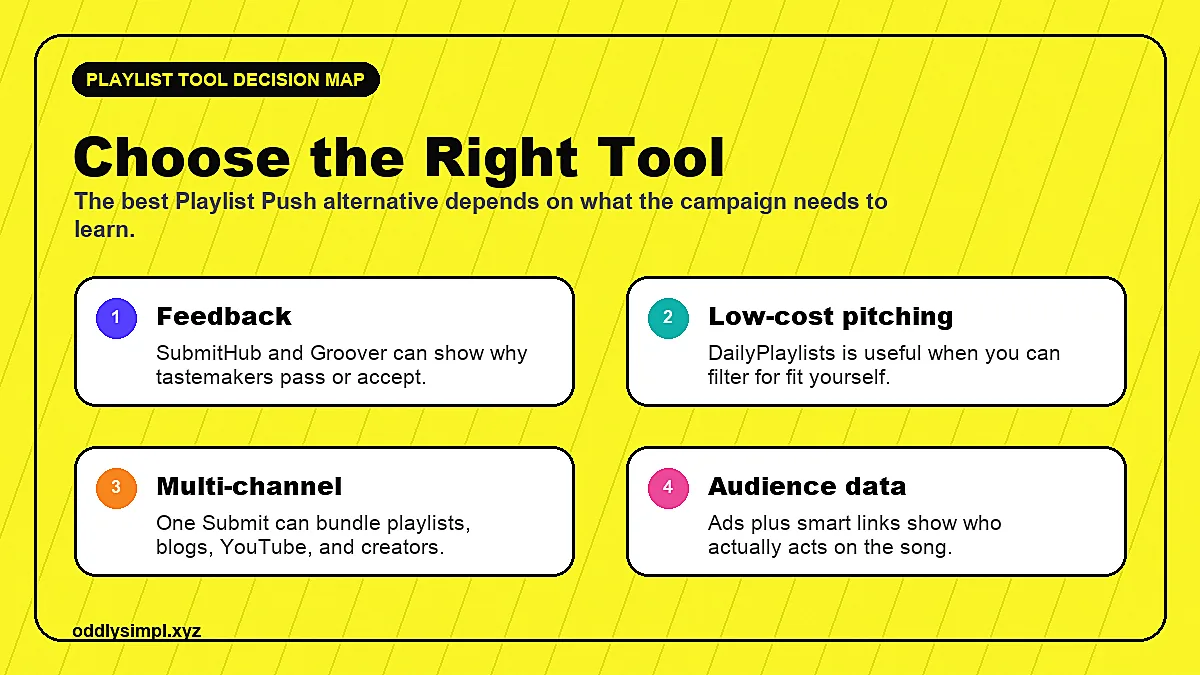
SubmitHub is useful when you want feedback and targeted pitching to blogs, curators, influencers, and other tastemakers. It is usually better for artists who want to learn how the market reacts to a song instead of chasing playlist volume.
Use it when you want affordable feedback, genre-specific pitching, and a clearer sense of why people are passing or accepting.
Skip it if you only care about stream count. Feedback can sting, but it is often more useful than a short-lived spike.
2. Groover
Groover is another submission marketplace that works well for curator, blog, label, radio, and influencer outreach. It can be useful when the campaign needs press and tastemaker response, not only Spotify playlist pitching.
Use it when your song has a story, a niche scene, or a clear editorial angle.
Skip it if you do not have time to personalize the campaign. Broad submissions with weak positioning usually feel expensive even when the platform itself is fair.
3. DailyPlaylists
DailyPlaylists is a good starting point for artists who want free or low-cost playlist submissions. It gives you access to a marketplace of playlist opportunities without making the release depend on one paid campaign.
Use it when you are early, organized, and willing to do the patient work of filtering for fit.
Skip it if you want a done-for-you strategy. Free tools still require taste, time, and follow-through.
4. One Submit
One Submit is broader than a pure playlist tool. It can help with Spotify playlists, TikTok creators, YouTube channels, blogs, online radio, and label submissions.
Use it when you want one submission workflow across several discovery channels.
Skip it if your real bottleneck is listener quality. More channels do not automatically mean better fans.
5. Spotify Ads and Meta Ads
Ads are not a direct Playlist Push replacement because they solve a different problem.
Playlist pitching asks curators, "Will you consider this song?" Ads ask listeners, "Do you care enough to click, save, follow, replay, or come back?"
That makes ads better for learning. You can test audience segments, creative hooks, countries, cities, and landing pages. Then you can compare the data inside Spotify for Artists, your smart-link platform, and ad reporting.
The downside is that bad ads waste money quickly. You need content, tracking, and a clear hypothesis. Cheap clicks are not the goal. Qualified listeners are.
6. A Done-for-You Spotify Promotion System
Some artists do not need another tool. They need the whole campaign connected.
That means:
- positioning the song before release day
- building short-form content around real angles
- setting up smart links and retargeting
- testing paid audiences carefully
- pitching playlists where the fit is real
- reading saves, follows, streams per listener, and source quality
- turning the results into the next release plan
This is where simpl. fits. We are not a playlist marketplace. We help independent artists use ads, content, and analytics to build real listener behavior instead of renting a prettier graph for two weeks.
How to Choose the Right Alternative
Use this simple decision rule:
- If you need feedback: use SubmitHub or Groover.
- If you need free playlist outreach: start with DailyPlaylists.
- If you need several submission channels: test One Submit.
- If you need audience data: use ads, smart links, and Spotify analytics.
- If you need a campaign plan: build the release system before buying promotion.
The more serious the release, the more you should care about what happens after the campaign ends.
Metrics to Watch No Matter Which Tool You Use
Do not compare services only by stream count. Compare them by listener quality.
- Save rate: did listeners want the song again?
- Follower growth: did they care about the artist beyond the track?
- Streams per listener: did people replay?
- Source of streams: did traffic come from believable places?
- Playlist fit: did placements match the genre, mood, and audience?
- Post-campaign baseline: did any momentum remain?
This is why music analytics matter. A campaign that teaches you who your listeners are is more valuable than a bigger number that disappears.
The Best Alternative Is Usually a Stack
The strongest answer is usually not one platform.
For an independent artist, a healthy stack might look like this:
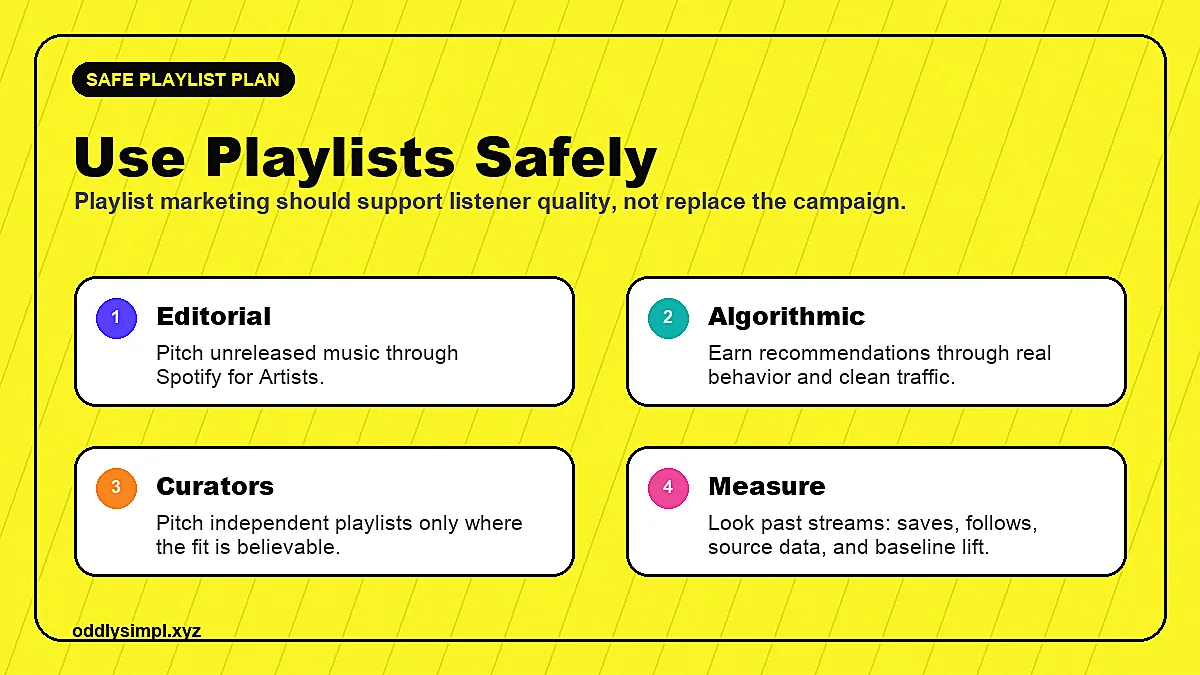
- Use Spotify for Artists to pitch the unreleased track.
- Use short-form content to create context before release day.
- Use a smart link to track clicks and platform choice.
- Use ads to test audiences and creative.
- Use SubmitHub, Groover, DailyPlaylists, One Submit, Playlist Push, or direct Spotify playlist submission for targeted curator outreach.
- Use Spotify for Artists to judge saves, followers, source of streams, and repeat listening.
- Use the results to plan the next single.
That stack is less exciting than buying a promise. It also gives you a career instead of a temporary spike.
When Playlist Push Still Makes Sense
Playlist Push can still make sense when:
- the song is highly playlistable
- the genre fit is obvious
- you already have a release plan around it
- you are treating placements as one channel, not the whole strategy
- you are prepared to judge the campaign by saves, follows, and retention
The problem is not using Playlist Push. The problem is expecting any playlist tool to do the job of positioning, content, fan building, and release strategy.
What simpl. Would Recommend
If you are early, start cheap. Build content, pitch manually, test free and low-cost submission tools, and learn what kind of listeners respond.
If you have a song that is already getting real reaction, use ads and analytics to find more people like that audience.
If you are preparing a serious release, do not make playlist pitching the center of the plan. Build the system first: release strategy, pre-save or waitlist, smart links, analytics, and targeted promotion.
And if you want help building the campaign around real listener behavior, start with the Spotify ads page.
The goal is not to find the cheapest way to get streams.
The goal is to find the cleanest way to learn who cares.
Keep building the strategy
-
Spotify promotion services
Understand what is legit, what is risky, and what actually builds fans.
-
Music analytics
Judge every campaign by listener quality, not just stream count.
-
Spotify ads for artists
Test audiences and creative instead of relying only on playlist consideration.
About the author

Anthony Pacheco
Anthony Pacheco is the founder of simpl., a former Sony Music analyst, and a Billboard-charting musician who has helped run 750+ artist marketing campaigns. He writes about real listener behavior, release systems, Spotify ads, and how artists can grow without fake playlist traffic.