Marketing Strategy · Updated July 3, 2026
Fake Spotify Playlists: Why Playlist Marketing Is a Bubble
I've watched artists go from 200 monthly listeners to 2,000 overnight and think they built a fanbase.
They didn't.
They bought themselves a hit of dopamine and a monthly subscription to disappointment. Playlist success is not the same thing as fanbase growth. A risky playlist campaign can manufacture the illusion of fans while making your real audience data harder to read.
The playlist economy has turned a lot of music discovery into background noise. Artists chase monthly listener counts, pay for playlist placements, and then wonder why the spike did not create saves, follows, merch buyers, ticket demand, or people who know their name.
I've seen this cycle destroy more careers than it's built.
Quick answer: are fake Spotify playlists bad for artists?
Yes. Fake Spotify playlists and low-quality paid playlist campaigns can hurt artists because they create artificial-looking listening patterns, pollute audience data, and produce streams without real fan behavior. Spotify's own artist support warns against paid third-party services that guarantee streams or playlist placement.
Not every independent playlist is fake. Some curators have real audiences. The problem is the guarantee economy: "pay us and we will get you streams." That is not music marketing. That is traffic with no proof of listener intent.
The Psychology of Fake Growth
When an artist sees their listeners jump from hundreds to thousands overnight, something happens in their brain. They think "holy shit, I 10x'd my fanbase. Let me do it again."
But when that playlist campaign ends, so do their listeners.
This creates an endless loop. Artists become psychologically dependent on the easy route instead of building something sustainable. They want the instant gratification of playlist placement over the harder work of real audience development.
The problem runs deeper than individual psychology. The entire indie music ecosystem has become structured around this addiction.
While major labels quietly moved away from playlist dependency years ago, desperate independent artists still throw money at playlist services. They're chasing yesterday's strategy while the industry has already evolved.
Fans of Playlists, Not Artists
Here is the brutal truth about playlist discovery: listeners are fans of the playlist, not your music.
When someone finds your song buried at track 47 of a "Sad Vibes" playlist, you become background noise inside a playlist they like. They're driving, working out, or busy in the real world where they don't care to dive into your artist universe.
Your music becomes background noise.
Compare this to organic discovery through social content. When someone scrolls TikTok and sees an artist post content with a hook that hits them emotionally, they put a name to a face. They're actively consuming content and discovering new music in a mindset primed for deeper engagement.
The difference is active versus passive discovery. Social media users are feeding their dopamine receptors and looking for new experiences. Playlist listeners want background music while they focus on something else entirely.
How to spot fake Spotify playlists
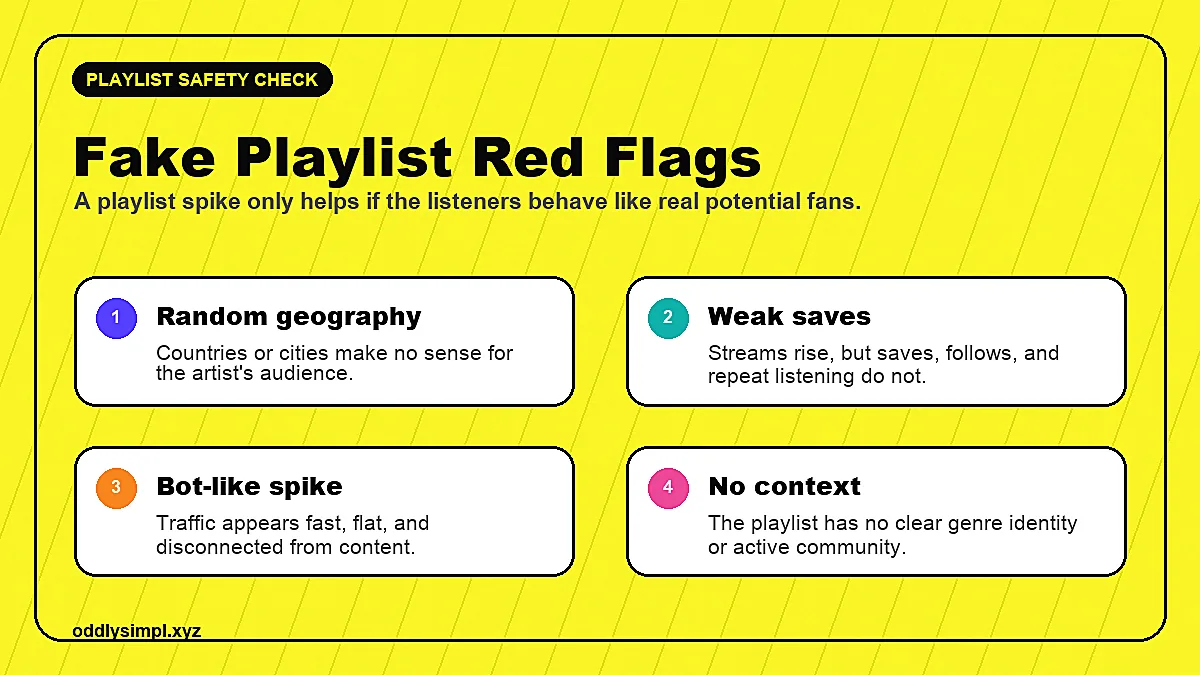
You do not need a perfect fake playlist detector to notice suspicious patterns. Start with the basics:
- Guaranteed streams or guaranteed placement: this is the biggest red flag. Legit promotion cannot promise how strangers will listen.
- Huge follower count, low visible engagement: a playlist with a big number but no recognizable brand, curator presence, or listener community deserves skepticism.
- Random genre mix: if the playlist jumps from unrelated styles with no editorial logic, your song may be there for a stream count, not a listener.
- Unnatural geography: if your campaign creates sudden streams from countries or cities that do not match your audience, watch closely.
- No saves, follows, or repeat listening: streams without listener behavior are weak signals.
- Short campaign spike, instant collapse: real discovery usually leaves some residue. Fake growth vanishes.
Tools that call themselves fake Spotify playlist checkers or detectors can be useful for clues, but they are not a substitute for reading your own Spotify for Artists data. The best detector is still listener quality.
What to check after a playlist add
| Signal | Good sign | Risk sign |
|---|---|---|
| Saves | Listeners save the track after hearing it | Streams rise but saves stay flat |
| Followers | Some listeners follow the artist profile | Monthly listeners rise with no follower movement |
| Streams per listener | People come back more than once | One-and-done passive listening |
| Source of streams | Playlist activity is balanced by profile, radio, search, or library streams | One playlist dominates the spike |
| Location data | Cities fit your real audience or campaign targeting | Random markets appear overnight |
If the data looks weird, pause the campaign. Do not keep feeding a channel because the public number feels good.
The Economics of Fake Engagement
The economics are simple: passive streams rarely turn into the behavior that pays an artist.
A fan who saves, follows, buys merch, joins a Discord, signs up for email, or comes to a show is worth more than a listener who appears once in Spotify for Artists and disappears when the playlist ends.
Playlist streams can help when they introduce the right person to the right song. They do not create superfans by themselves.
The Real Currency: Community Building
The artists who understand this are building something completely different.
They're creating communities through Discord servers, SMS lists, and live streams. These platforms let artists showcase their personality and worldview with depth that playlist placement never could.
Music is art created from an artist's worldview and experience. But many artists are terrified to show who they are.
The successful artists who break through this fear realize something powerful: deeper personal connection amplifies their music rather than distracting from it.
If you want a practical owned-audience path, read the Discord for musicians guide and the music marketing starter kit.
The Content Structure That Works
Organic discovery follows a simple but powerful structure: hook, song, call to action.
The hook can be text on screen that relates directly to the fan. "If you've ever felt heartbroken, this song is for you." Or "If you're a fan of Artist X, Y, and Z, you'll love this."
This structure works because it creates context before the music plays. The listener knows why they should care before they hear the first note.
Playlist discovery provides zero context. Your song appears between tracks from completely different artists with no explanation of why someone should pay attention to you specifically.
For a more tactical content system, use the social media music promotion guide and the TikTok music promotion guide.
How to report a fake Spotify playlist or artificial streams
If you believe your track was added to a suspicious playlist, document the playlist URL, dates, source-of-streams change, country/city changes, and any outreach or payment history. Then contact your distributor and Spotify for Artists support with the cleanest timeline you can provide.
Do not keep paying the same source while you investigate. If the playlist is creating artificial-looking activity, more volume does not make the data safer. It makes the mess bigger.
What to do instead of buying playlist spikes
- Use playlist pitching selectively, not as the whole plan.
- Build a release strategy before the song drops.
- Test short-form content angles that give the song context.
- Use smart links so you know where listeners go.
- Run ads only when you can measure saves, follows, repeat listening, and audience quality.
- Build owned channels: email, SMS, Discord, merch buyers, show RSVPs.
For safer curator outreach, start with the Spotify playlist submission guide. The Spotify promotion services guide breaks down what is legit, what is risky, and when promotion is worth paying for.
Why the Bubble Will Burst
The playlist economy is fundamentally unsustainable because it creates no lasting value for anyone involved.
Artists don't build real fanbases. Listeners don't discover music they connect with. Platforms optimize for passive consumption rather than active engagement.
Meanwhile, the artists building real communities are creating revenue streams that do not depend on algorithmic placement or playlist politics.
They own their audience relationships through direct communication channels. When platform algorithms change or playlists disappear, their connection to fans remains intact.
Organic growth matters because it creates lasting value in an industry built on human connection.
The playlist bubble will burst because it was never built on real relationships in the first place.
Smart artists are already building something better.
Fake Spotify Playlists FAQ
Are fake Spotify playlists bad for artists?
Yes. Fake Spotify playlists can create artificial-looking listening patterns, pollute audience data, and produce streams without saves, follows, repeat listening, merch buyers, ticket demand, or real fan behavior.
How do you spot a fake Spotify playlist?
Watch for guaranteed streams, guaranteed placement, random genre mixes, sudden streams from unrelated countries, high streams with no saves or follows, and a spike that disappears as soon as the placement ends.
Can paid playlist promotion be safe?
Paid playlist promotion can be safer when the curator is transparent, the genre fit is real, and the campaign is measured by listener quality. It is risky when the offer hides sources or guarantees exact streams.
What should artists do instead of buying playlist spikes?
Artists should build a release system around content, smart links, selective pitching, ads, owned fan capture, and analytics so the campaign creates useful listener behavior instead of temporary graph movement.
If you want help replacing fake playlist spikes with cleaner audience growth, work with simpl. We build Spotify ad campaigns, content tests, and release systems around real listener behavior.
Keep building the strategy
-
Music marketing strategies
Build the full system around content, ads, release timing, and fan retention.
-
Music analytics
Use listener data to make better release, content, and ad decisions.
-
Spotify ads for artists
Turn the right listeners into repeat fans with a campaign built around your sound.
About the author

Anthony Pacheco
Anthony Pacheco is the founder of simpl., a former Sony Music analyst, and a Billboard-charting musician who has helped run 750+ artist marketing campaigns. He writes about real listener behavior, release systems, Spotify ads, and how artists can grow without fake playlist traffic.