Marketing Strategy · Updated July 3, 2026
Music Release Strategy: 2026 Plan for Artists
Most release plans fail because artists treat release day like the finish line.
It is not.
Release day is one checkpoint inside a longer system. The song needs context before it drops, attention when it drops, and follow-through after the first-week spike fades. Otherwise you get the thing every artist hates: a song you care about deeply disappearing after one announcement post and a few Instagram stories.
A real music release strategy answers three questions:
- Who is this song for?
- Why should they care before they hear it?
- What happens after they listen?
If you cannot answer those, no pre-save link, playlist pitch, ad campaign, or distributor feature is going to save the release.
Quick answer: a good music release strategy gives the song context before it drops, directs attention during release week, and uses the post-release data to decide what deserves more content, more budget, or a different angle.
The Simple Release Strategy Framework
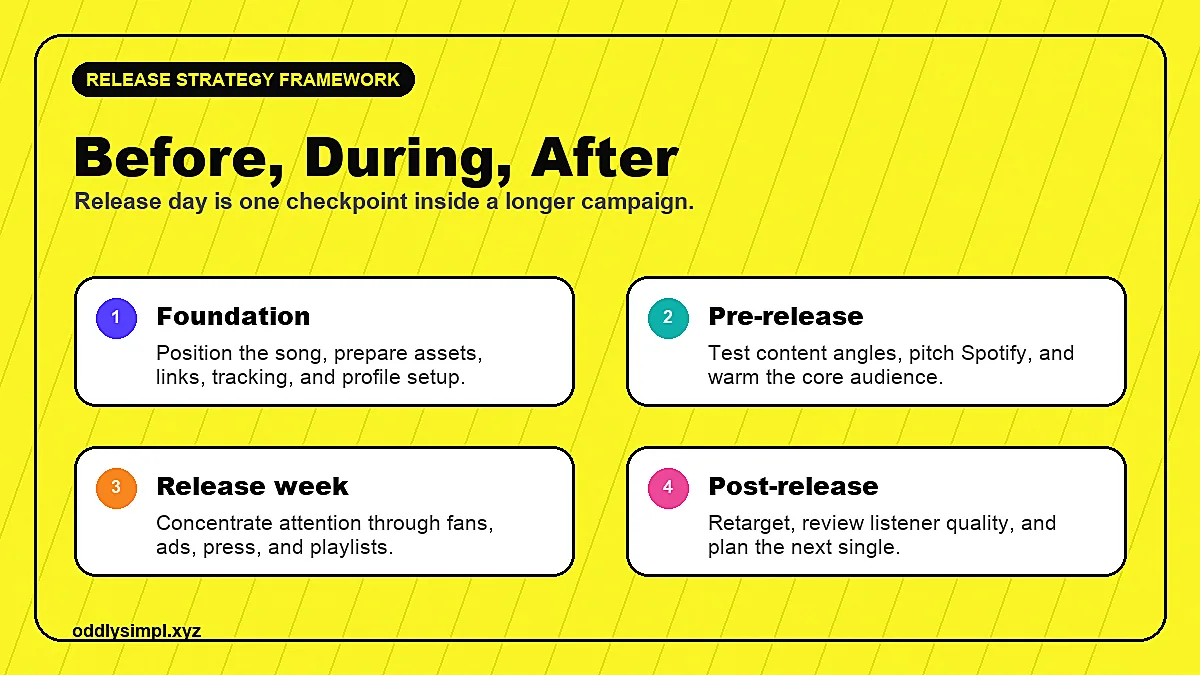
Think of your release in four phases:
- Foundation: audience, positioning, assets, links, tracking, and timeline.
- Pre-release: story, content, pre-save or waitlist, community touchpoints, and Spotify pitch.
- Release week: concentrated attention, ads, email, socials, playlist outreach, and fan activation.
- Post-release: retargeting, analytics, follow-up content, alternate versions, videos, and the next release.
The mistake is trying to build all four phases during release week. By then you are already late.
Music Release Strategy Template
A useful music release strategy template should not be a giant checklist of every possible tactic. It should force the decisions that shape the campaign:
- Goal: what is this release supposed to create: saves, followers, video views, email signups, tickets, sales, or chart activity?
- Audience: who is most likely to care, and what artists, scenes, cities, moods, or stories help identify them?
- Angle: what lyric, story, visual, or moment makes the song easier to care about?
- Timeline: what happens 6 weeks out, 4 weeks out, release week, and 2-4 weeks after?
- Channels: what role do TikTok, Reels, YouTube, email, playlist pitching, press, smart links, and ads each play?
- Measurement: what will tell you the campaign found real listeners instead of empty attention?
If you want the task version, use the music release planner template. Use this page for the strategy behind the tasks.
Single Release Strategy vs Album Release Strategy
A single release strategy should be focused. One song, one clearest audience, one strongest content angle, one clean link path, and a short feedback loop. The job is to learn who responds and give the song multiple entry points without overwhelming people.
An album release strategy needs more sequencing. You are building a world, choosing lead singles, deciding whether to use a waterfall rollout, planning press and visual assets, and giving fans a reason to care about the full project when it arrives.
For most independent artists, the mistake is treating an album like one giant release day. If the project matters, build momentum before it lands. Use singles to test audience response, then make the album drop feel like the payoff.
Phase 1: Build the Foundation
Before you announce anything, get the boring parts handled. Boring is where a lot of campaigns win.
- Pick the goal: streams, saves, Spotify followers, email signups, music video views, ticket sales, or chart activity. Do not pretend one campaign can optimize for everything equally.
- Set the release date: give yourself at least four weeks if you want time for content, pitching, ads, and smart-link setup.
- Build the visual world: cover art, vertical clips, behind-the-scenes footage, lyric graphics, canvas ideas, and press photos.
- Set up the link path: pre-save, smart link, landing page, pixel, UTMs, and email capture where it makes sense.
- Write the story: what the song is about, who it is for, and what emotional moment the content should communicate.
This is where a music release planner helps. Not because a template is magic, but because it keeps the moving pieces from living in your head until something falls apart.
Phase 2: Pre-Release Without Annoying Your Fans
Pre-release is not "post the cover art six times and beg people to pre-save."
Pre-release is where you teach people how to care about the song.
Useful pre-release content includes:
- the line that explains the emotional center of the song
- a raw performance of the hook
- the story behind the lyric
- studio or writing clips that show the song becoming real
- comparison content for fans of similar artists
- a short video explaining who the song is for
- fan polls, title reveals, cover reveals, and countdown moments
Pre-saves can still be part of this, but they should not be the whole strategy. A good pre-save campaign is a reminder and fan-data tool. It is not a cheat code.
How Many Weeks Before Release Should You Start?
For most independent artists, start four to six weeks before release day.
That gives you enough time to test content, explain the song, pitch Spotify, warm up your existing audience, and build a small retargeting pool. If you are running a larger campaign with a video, PR, physical product, or tour dates, start eight to twelve weeks out.
If you are less than two weeks away, simplify. Focus on the best content angle, the cleanest smart link, the Spotify pitch, and a tight release-week push. Do not try to invent an entire rollout at the last second.
Spotify Pitching and Release Radar
Submit your song through Spotify for Artists at least seven days before release. Earlier is better.
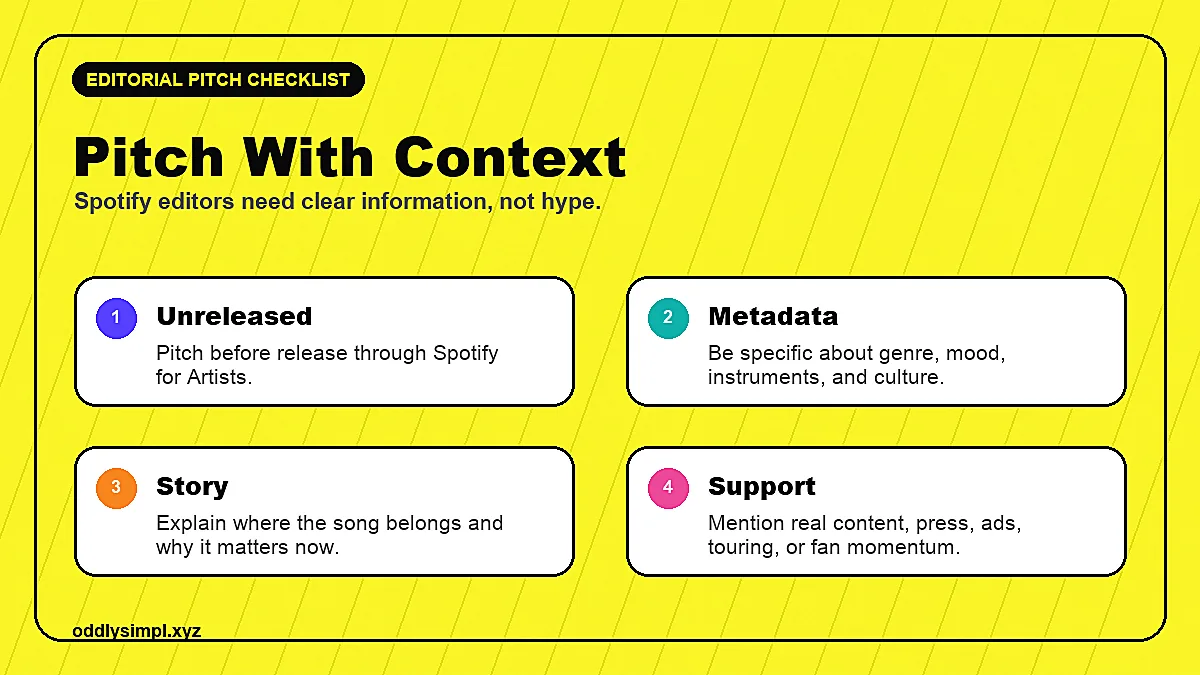
Your pitch should be clear and specific: genre, mood, instruments, similar artists, the story behind the song, and any marketing plans that show the release has momentum. Do not use hype language that says nothing. "This song is a vibe" is not a pitch.
Even if you do not land editorial, your release still goes to followers through Release Radar. That means follower growth before release day matters. Every real Spotify follower makes the next release stronger.
When to Use a Waterfall Release Strategy
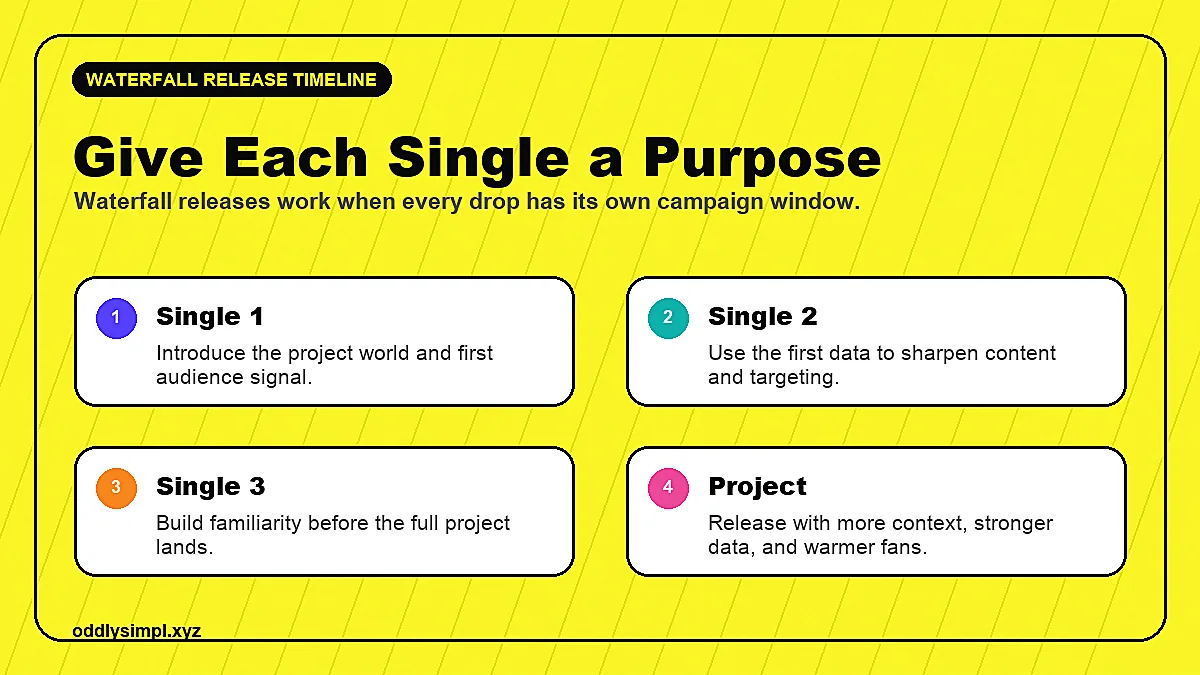
A waterfall release strategy works best when you have multiple songs and want each track to create its own moment before the full project drops.
Instead of dropping a whole EP or album at once, you release singles every four to six weeks. Each single gets its own content cycle, pitch opportunity, ad test, and data read. By the time the project arrives, listeners already know some of the songs and the algorithm has more behavior to work with.
Use a waterfall when:
- you have three or more strong songs ready
- you can make content for each single
- your audience is still growing and needs repeated touchpoints
- you want more Spotify pitch and Release Radar opportunities
- you are building toward an EP, album, tour, or larger story
Do not use a waterfall because it sounds strategic. If the songs are not ready or you cannot promote each one, spacing them out will not fix the problem.
Release Week: Concentrate Attention
Release week is where you ask directly, but the ask should feel earned because you spent the pre-release phase building context.
Your release-week checklist should include:
- announce the song everywhere with a clear streaming link
- email or text your warmest fans
- pin the release on your social profiles
- update Spotify Artist Pick, Canvas, bio, and links
- reply to every comment and DM you can
- post multiple content angles, not the same graphic repeatedly
- share fan reactions, playlist adds, behind-the-scenes, and performance clips
- run ads only to content or audiences that show real signal
If you are trying to chart, release week matters even more. First-week streaming, sales, PR, and ad timing need to be coordinated. Read the Billboard charting guide if that is part of the goal.
Paid Ads: When They Help and When They Do Not
Ads help when you have a song, content angle, and audience hypothesis worth testing.
Ads do not help when you are using them to avoid the work of positioning the song.
The best release ads usually start with creative testing. Which clip makes people stop? Which lyric makes people comment? Which audience saves the song instead of clicking once? Once you know that, you can scale with more confidence.
This is also where music analytics matter. Do not judge ads only by cost per click. Judge them by listener quality: saves, follows, streams per listener, source of streams, and whether your post-campaign baseline rises.
Smart Links and Tracking
Your release link should do more than route fans to Spotify.
A good smart link gives listeners platform choice, tracks clicks, helps build retargeting audiences, and shows which channels are driving action. If you only link directly to Spotify from every post, you lose data and make the experience worse for fans who use Apple Music, YouTube, Amazon, or another platform.
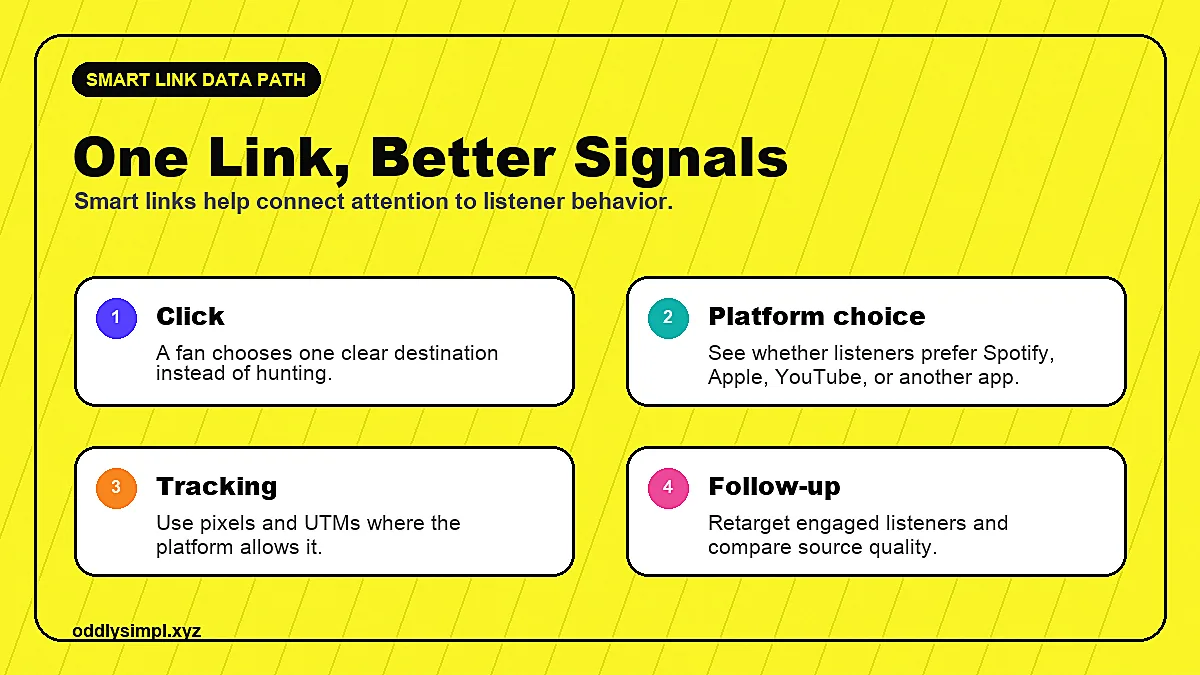
At minimum, track:
- which posts or ads drive clicks
- which platforms fans choose
- which countries and devices show demand
- whether clicks turn into saves, follows, or repeat listeners
Post-Release: Do Not Let the Song Die
Most artists stop promoting too early.
The week after release is not cleanup. It is the second wave. Now you have real listener data, fan reactions, playlist adds, comments, and performance clips to build from.
Post-release ideas:
- turn the best lyric into new short-form clips
- post an acoustic, live, sped-up, slowed, or alternate version
- retarget people who watched, clicked, or engaged
- pitch local or genre press using early traction
- share the story behind specific lyrics
- thank fans by name and repost user-generated content
- use city data to plan shows, ads, or collaborations
The goal is to keep giving people new reasons to enter the song.
A 6-Week Music Release Timeline
6 Weeks Out
Finalize masters, cover art, distributor upload, release date, smart-link setup, and content concepts. Start filming more than you think you need.
4 Weeks Out
Submit the Spotify pitch, announce the song, start telling the story, and test your first content angles. If you use a pre-save, launch it here.
2 Weeks Out
Double down on the best-performing hooks. Email your list. Warm up retargeting audiences. Make sure every profile points to the release.
Release Week
Post daily with different angles. Activate fans directly. Run the strongest ad creative. Watch saves, follows, comments, and source quality.
2 Weeks After
Study the data. Keep promoting the strongest content. Retarget engaged listeners. Pitch follow-up stories. Decide what the next release should learn from this one.
The Release Is a System
The artists who grow consistently do not treat every song like a lottery ticket.
They build a loop: release, learn, adjust, repeat. Each campaign makes the next one smarter. Each song teaches them more about their audience. Each piece of content shows them which story lands.
That is the real strategy.
If you want help building the whole release system, work with simpl. We help independent artists turn songs into campaigns with content, Spotify ads, analytics, and release planning that does not reset to zero every time.
Keep building the strategy
-
Music release planner
Turn the strategy into a release checklist and timeline.
-
Waterfall release strategy
Use multiple singles to build momentum before a full project.
-
Pre-save campaign guide
Use pre-saves as a warm-audience tool instead of a vanity metric.
About the author

Anthony Pacheco
Anthony Pacheco is the founder of simpl., a former Sony Music analyst, and a Billboard-charting musician who has helped run 750+ artist marketing campaigns. He writes about real listener behavior, release systems, Spotify ads, and how artists can grow without fake playlist traffic.