Tools · Updated July 9, 2026
Music Smart Links: Best Tools and Setup Guide
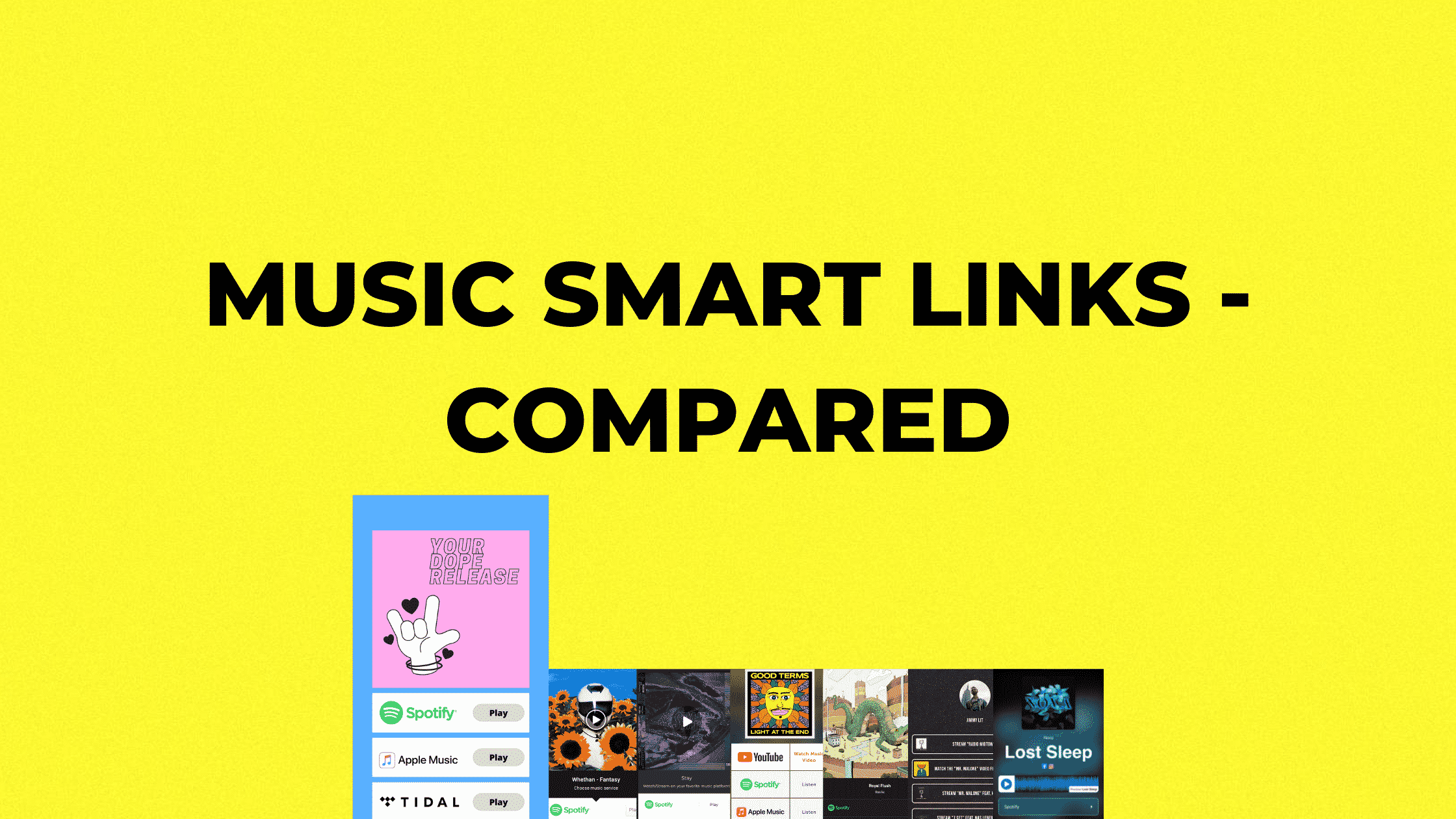
I've seen a lot of artists promote a new single and only link to Spotify.
I get why. Spotify is the platform everyone talks about. But when you send every fan to Spotify, you make two bad assumptions: that every listener uses Spotify, and that the only thing worth tracking is a stream.
That is how you lose data.
A smart link gives fans the choice of where to listen and gives you a cleaner picture of what your marketing is doing. It can show which TikTok drove clicks, which country is responding, which platform your audience prefers, and whether your release link is turning attention into action.
Used correctly, smart links become part of your release system.
What Are Music Smart Links?
A music smart link is a landing page that sends fans to your song, video, pre-save, merch, tickets, or profile across multiple platforms from one URL.
Instead of posting separate links for Spotify, Apple Music, YouTube, Amazon, Deezer, Bandcamp, and SoundCloud, you send people to one page. They choose their preferred platform. You track the click.
The best music smart links do three jobs at once: give fans the right listening option, show you which promotion source created the click, and help you build a follow-up audience for the next release.
Most music smart-link tools can also support:
- pre-save and pre-add campaigns
- link-in-bio pages
- retargeting pixels
- geography and device analytics
- platform click-through data
- email or fan-data capture
- release-day link scheduling
- conversion tracking for ads
The page is useful because it creates a feedback loop between the click, platform choice, follow-up audience, and next campaign decision.
Music Smart Links: Quick Setup
If you are setting up a music smart link for one release, keep the first version simple:
- Use one campaign URL: one song, video, pre-save, merch drop, ticket page, or album.
- Add the main destinations: Spotify, Apple Music, YouTube, Amazon, SoundCloud, Bandcamp, or wherever your fans listen.
- Name every traffic source: TikTok, Reels, YouTube, email, ads, creators, Discord, and press should use trackable campaign labels.
- Add pixels before launch: retargeting only works if the pixel is active before the traffic comes in.
- Review listener quality: compare clicks with saves, follows, repeat listening, email signups, and platform choice.
A smart link does not fix weak promotion. It helps you see which promotion deserves another round.
Best Free Smart Links for Music
The best free smart link for music is the one that solves your current job without hiding the data you need. A brand-new artist may only need a clean release page and platform buttons. An artist running ads needs stronger analytics, pixels, and campaign tracking.
When comparing free smart-link tools, check for:
- Unlimited or realistic link limits: one release link is not enough if you release often.
- Pre-save support: useful before release day if the tool can switch cleanly to a live link later.
- Analytics: at minimum, source, country, device, and platform-click data.
- Pixel support: important if you want to retarget people who clicked.
- Clean fan experience: fast page, obvious buttons, no distracting clutter.
Free plans are fine for testing. Do not let "free" become the reason you lose campaign data. If a tool cannot tell you where clicks came from or which platform fans chose, it may be too limited for a serious release.
How to Create a Music Smart Link
A music smart link generator should make setup simple, but the strategy is still yours. Build the link around one clear action.
- Choose the release or campaign. One song, album, video, pre-save, ticket page, or merch drop.
- Add the destination links. Spotify, Apple Music, YouTube, Amazon, SoundCloud, Bandcamp, or wherever the fan can act.
- Use clean campaign names. Label links by release, date, platform, and campaign source so the data makes sense later.
- Add pixels before promotion starts. Do this before ads, creator posts, or big social pushes, not after the traffic already happened.
- Test on mobile. Most fans will click from TikTok, Instagram, YouTube, or text messages.
- Switch pre-save links on release day. Once the song is live, the link should point people to listening, not the old pre-save ask.
If the setup takes longer than the campaign strategy, simplify the page. The listener should not have to solve a puzzle to hear the song.
Music Link Generator vs Smart Link
People search for a music link generator when they need one URL for Spotify, Apple Music, YouTube, Amazon, Deezer, SoundCloud, Bandcamp, and the rest.
The generator creates the page. The smart link strategy decides what the page should prove.
- Music link generator: creates the URL, artwork, platform buttons, and basic landing page.
- Smart link: connects that URL to campaign source tracking, platform preference, geography, pixels, and follow-up audiences.
If you only need a clean link for one post, a simple generator can work. If you are running a release campaign, ads, creator posts, email, or a pre-save, you need the tracking layer too.
Pre-Save Link vs Smart Link
A pre-save link is for before the release. A smart link is for release day and after. They can live inside the same tool, but they do different jobs.
| Link type | When to use it | Main job |
|---|---|---|
| Pre-save link | Before the song is live | Collect early intent, reminders, fan data, and release-day momentum |
| Release smart link | Once the song is live | Send fans to their preferred platform and track what promotion drove action |
| Link in bio | Always-on profile traffic | Route people to your current priority: release, tickets, merch, email, or video |
For a deeper pre-release breakdown, use the pre-save campaign guide. For this page, the key idea is simple: do not keep promoting a pre-save link after the song is already out.
Smart Link vs Link in Bio
Artists often use these terms like they are the same thing, but they solve different problems.
| Type | Best for | What it should include |
|---|---|---|
| Smart link | One song, video, pre-save, album, or campaign | Streaming buttons, preview, pixel, platform tracking, campaign source tracking |
| Link in bio | Your main social profile link | Latest release, email signup, merch, tour dates, YouTube, Spotify follow, best offer |
Your smart link is campaign-specific. Your link in bio is your mini-homepage.
Do not cram every possible link onto your release smart link. If someone clicked because they want the song, give them the song. If you want them to buy merch or join your email list, make that a secondary step after the main action.
Music Landing Page vs Smart Link
A music landing page is the visible page fans land on. A smart link is the campaign system behind that page.
| Term | What it means | Use it for |
|---|---|---|
| Music landing page | The fan-facing page with artwork, copy, and buttons | Making the release easy to understand and click |
| Music smart link | The landing page plus routing, analytics, pixels, and campaign data | Measuring which posts, ads, or emails created listener action |
| Link in bio | An always-on profile hub | Routing social profile traffic to current priorities |
Artists usually need all three, but not on the same page. Keep release smart links focused. Use the bio link for everything else.
Why Smart Links Matter for Music Marketing
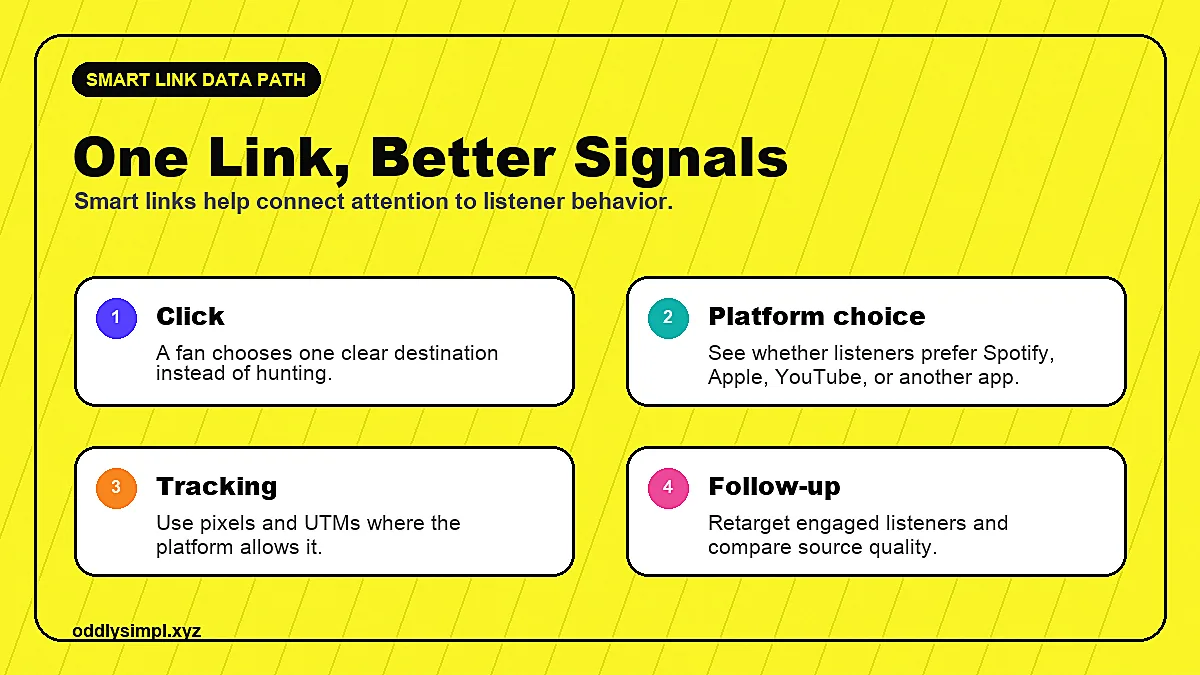
Smart links help with four things: fan experience, measurement, retargeting, and first-party fan data.
1. Fan Experience
Not everyone uses Spotify. Some fans are on Apple Music, YouTube, Amazon, Deezer, SoundCloud, Bandcamp, or Tidal. A smart link lets them choose without making your caption look like a messy list of URLs.
2. Measurement
If you post a direct Spotify link everywhere, you cannot easily tell which post, ad, email, or creator mention drove the listener. A smart link gives you a cleaner middle layer.
At minimum, you want to know:
- which source drove the click
- which platform fans chose
- which countries and devices responded
- which links are underperforming
- whether clicks match movement in Spotify for Artists
3. Retargeting
If your smart-link tool supports pixels, you can build audiences of people who clicked, watched, pre-saved, or interacted with the release. Warm audiences beat cold guesses more often.
This is especially useful when you are running Spotify ads or planning a multi-week release campaign.
4. First-Party Fan Data
First-party data is the part many artists skip. A click is useful for attribution, but an email or phone opt-in can create a real follow-up path. That matters when TikTok stops showing the video, Instagram reach drops, or the release needs another push in week two.
This is where a tool like Laylo can fit the smart-link stack. Use it when the campaign needs a Drop page, SMS or email capture, release reminders, and fan communication after release day. Compare it with Feature.fm, Linkfire, Hypeddit, and Spotify Countdown Pages based on the job: fan capture, platform routing, attribution, or native Spotify pre-release support.
Best Smart Link Tools for Musicians in 2026
No single tool wins for every artist. The best smart link service depends on whether you care most about simplicity, pre-saves, analytics, fan data, ads, or label-level attribution.
Laylo
Laylo is strongest when the smart-link or pre-save job includes fan capture and release reminders. Its pre-save documentation explains how Spotify pre-saves work through Drop pages and why fan authorization, phone numbers, email, and notifications matter after the click.
Best for: artists who want pre-saves, SMS or email capture, Drop pages, and a direct follow-up path for release day.
Feature.fm
Feature.fm is one of the most artist-focused options. It offers release links, pre-save links, future saves, contest pages, bio links, fan data tools, and analytics. Their pricing page also shows free smart links and pre-saves, which makes it accessible for artists who are not ready for a bigger stack yet.
Best for: independent artists who want music-specific smart links, pre-saves, and fan capture in one place.
Linkfire
Linkfire is strong on analytics, attribution, and industry-grade music landing pages. Apple Music for Artists describes Linkfire as a music marketing and analytics platform used to create smart links and landing pages that let fans listen on Apple Music and other services.
Best for: teams that care about clean analytics, attribution, and more professional campaign reporting.
ToneDen
ToneDen lets artists create music smart-link campaigns and landing pages with popular music service buttons. It has historically been popular with artists running social ad funnels because of its campaign-building workflow.
Best for: artists who want simple music landing pages and are also thinking about paid social campaigns.
Hypeddit
Hypeddit combines smart links, pre-saves, download gates, fan engagement tools, and music promotion features. It is especially useful for artists who want fan actions tied to downloads, follows, or pre-release campaigns.
Best for: artists using download gates, pre-saves, and fan-action campaigns.
Linktree, Beacons, and General Bio-Link Tools
General link-in-bio tools are fine when you need a simple profile hub. They are not always the best choice for release analytics. Use them for your main profile link, but consider a music-specific smart link for actual release campaigns.
Smart Link Tool Comparison
| Tool | Best use | Watch out for |
|---|---|---|
| Laylo | pre-saves, Drop pages, SMS/email capture, release alerts | less focused on pure streaming attribution than some smart-link tools |
| Feature.fm | artist smart links, pre-saves, fan capture | advanced features may require paid plans |
| Linkfire | analytics, attribution, label/team reporting | can be more tool than a brand-new artist needs |
| ToneDen | music landing pages and campaign workflows | make sure the reporting matches what you need |
| Hypeddit | download gates, pre-saves, fan-action campaigns | keep pages focused so fans do not get distracted |
| Linktree/Beacons | simple link in bio | less music-specific campaign attribution |
What to Include on a Release Smart Link
Your release smart link should have one main job: get the listener to the song with as little friction as possible.
- Spotify
- Apple Music
- YouTube or YouTube Music
- Amazon Music
- SoundCloud or Bandcamp if relevant
- a short preview or artwork that makes the page feel intentional
- retargeting pixels if you are running ads
- email capture only if it does not distract from the listening action
Keep the page clean. More choices can create decision fatigue.
What to Include in Your Link in Bio
- Your latest release (with smart link to all streaming platforms)
- Spotify follow link
- Email list signup
- Merch store
- Upcoming tour dates or ticket links
- Your most important social profiles
- Your strongest current offer, like a release planner, community, or campaign application
Keep it focused. Too many links create decision paralysis. Prioritize what you want fans to do most.
How Smart Links Fit Into a Release Strategy
Smart links should be built into your music release strategy, not added at the last second.
Before release day, use a pre-save or pre-add link to collect early intent. On release day, switch to a live smart link that sends fans to every platform. After release day, use the data to see which content and channels drove the most action.
For a waterfall rollout, create a link for each single and keep the campaign tags clean. That way you can compare which song, visual, country, or content angle pulled the most qualified listeners.
How to Track Smart Link Performance
Skip the weak question: "How many clicks did the link get?" Ask better questions:
- Which source drove the click?
- Which platform did people choose?
- Which country or city over-indexed?
- Did clicks turn into Spotify saves, followers, or repeat listeners?
- Did the campaign create a higher post-release baseline?
- Which audience should you retarget?
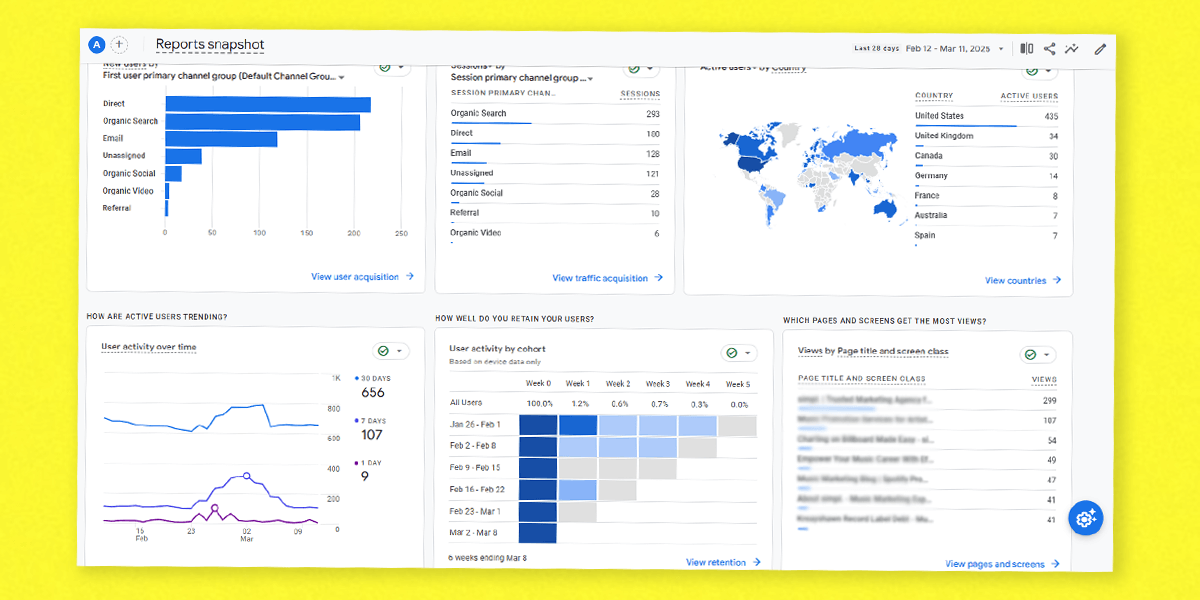
Then compare that with music analytics inside Spotify for Artists, Apple Music for Artists, YouTube Studio, and your ad platform. If a TikTok drives 2,000 smart-link clicks but no saves or follows, the traffic may be curious but not qualified. If a smaller ad set drives fewer clicks but better saves, that is the audience you keep testing.
Common Smart Link Mistakes
- Only linking to Spotify: you lose fans who prefer other platforms and lose data about platform preference.
- Adding too many buttons: more options can reduce action.
- No tracking tags: every campaign source should be identifiable.
- No pixel setup: you miss retargeting audiences you already paid or worked to reach.
- Using one link forever: release links, bio links, pre-save links, and merch links have different jobs.
- Judging by clicks only: clicks are not fans. Saves, follows, repeat listens, and email signups matter more.
The Simple Setup I Recommend
- Create one link-in-bio page for your profile.
- Create a separate smart link for every release.
- Use a pre-save only when you have enough warm audience to make it meaningful.
- Add pixels before you start driving traffic.
- Use campaign tags for TikTok, Instagram, email, ads, and creators.
- Review the data seven days and thirty days after release.
Smart links will not make people care about a song by themselves. But they make it much easier to understand what happens when people do care.
Need help building the release setup around smart links, ads, and analytics? Work with simpl. We help artists turn attention into listener data and listener data into smarter campaigns.
Keep building the strategy
-
Music release strategy
Place smart links inside the full pre-release and post-release system.
-
Music analytics
Read smart-link clicks alongside saves, follows, and listener quality.
-
Pre-save campaign guide
Know when a pre-save link helps and when it becomes a vanity metric.
About the author

Anthony Pacheco
Anthony Pacheco is the founder of simpl., a former Sony Music analyst, and a Billboard-charting musician who has helped run 750+ artist marketing campaigns. He writes about real listener behavior, release systems, Spotify ads, and how artists can grow without fake playlist traffic.