Marketing Strategy · Updated July 9, 2026
How to Get Your Music Heard: 2026 Artist Plan
If you are asking how to get your music heard online, on Spotify, by labels, or by real fans, you are probably asking a bigger question: how do I get strangers to care long enough to listen again?
Most artists do not need another random playlist link, one more out-now post, or a viral fantasy. They need a system that helps the right listeners find the song, understand why it matters, and take a next action.
That means the work is part music, part positioning, part content, part Spotify setup, and part measurement. If you only chase exposure, you will miss the listener behavior that turns one song into a fanbase.
Quick Answer: The Best Way to Get Your Music Heard
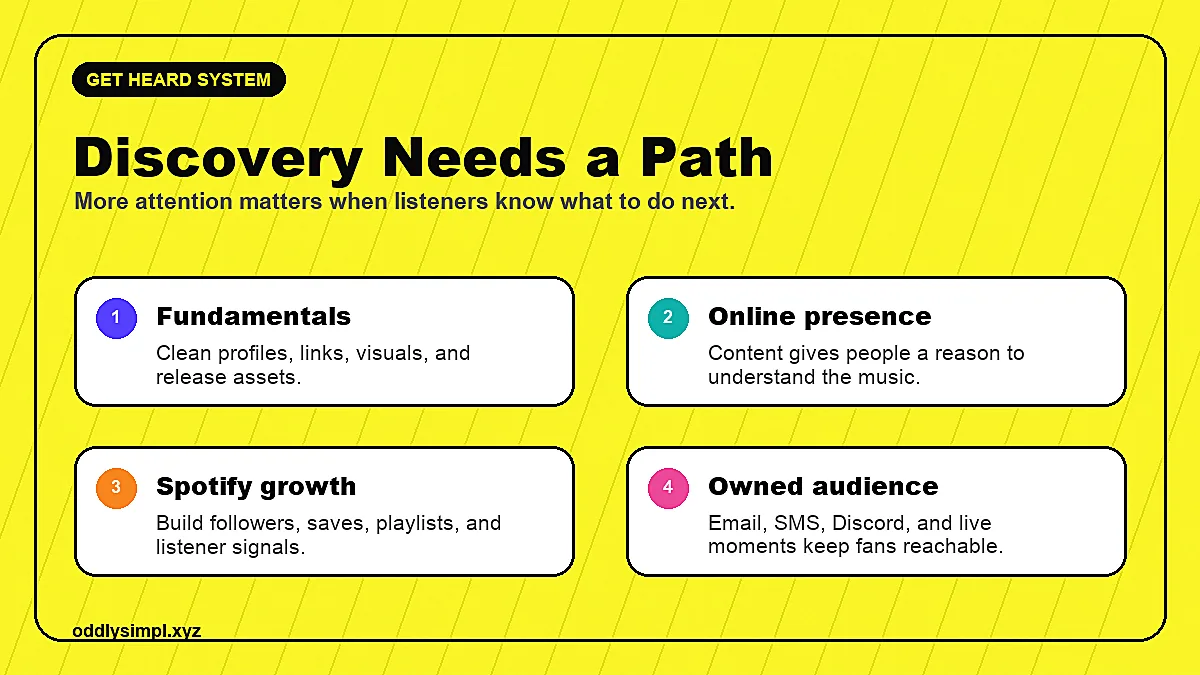
The best way to get your music heard is to build a repeatable discovery system, not rely on one lucky platform. Start with a good song, a clear artist story, consistent short-form content, clean streaming profiles, a smart link, and weekly measurement of saves, follows, repeat listening, clicks, and where listeners come from.
Then use each channel for a specific job:
- TikTok, Reels, and Shorts: create curiosity before someone clicks.
- Spotify: turn attention into saves, follows, repeat listening, and algorithmic signals.
- YouTube: give the song search visibility and longer-form context.
- Email, SMS, and Discord: keep warm fans reachable for the next release.
- Ads: test audiences and creative when you have a clear hypothesis.
- Playlists, blogs, and radio: use them as support, not the whole plan.
How to Get Your Music Heard Online, for Free, and by Labels
Each goal needs a different first move.
| Goal | Best first move | Proof to measure |
|---|---|---|
| Get heard online | Turn the song into repeatable short-form hooks, YouTube uploads, smart links, and search-friendly assets. | Watch time, profile visits, link clicks, saves, follows, and repeat listening. |
| Get heard for free | Use content, collaborations, local scenes, Discord, Reddit, blogs, newsletters, and selective playlist pitching. | Replies, shares, saves, playlist adds from listeners, email signups, and real comments. |
| Get heard by record labels | Build proof before pitching: releases, live demand, content traction, press, audience geography, and a clean EPK. | Consistent growth, repeat fans, clear positioning, and evidence strangers already care. |
Record labels, managers, playlist curators, and blogs respond better when the public has already given them a reason. Build the signal first, then pitch with receipts.
How to Get My Music Heard When I Am Starting From Zero
If you are starting from zero, shrink the goal. Your first job is not reaching everyone. Your first job is finding the first small pocket of people who understand the song fast.
Pick one song and build five angles around it: a lyric hook, a story behind the song, a raw performance, a similar-artist bridge, and one direct fan question. Post those angles across short-form platforms, send listeners through a trackable link, then watch which angle creates profile visits, saves, follows, comments, or repeat listening.
That is how you get out of guessing. You are not trying to prove the whole career in one week. You are trying to find the first signal worth building around.
Step 1: Get Your Fundamentals Right
Before promoting your music, make sure the foundation is solid:
- Quality recording: Your music needs to sound professional. You don't need a $100,000 studio budget, but you do need a mix and master that holds up next to other music in your genre on Spotify.
- Professional artwork: Cover art is your first impression. Invest in a designer or learn the basics of graphic design. Low-quality artwork signals low-quality music to new listeners.
- Complete streaming profiles: Your Spotify for Artists profile should have a bio, professional photos, and a pinned track. Same for Apple Music. These profiles are where new fans form their first opinion of you.
Step 2: Build Your Online Presence
- Choose your primary platform: You can't be everywhere. Pick one or two platforms where your target audience spends the most time. TikTok and Instagram matter most for many under-35 listeners.
- Create consistently: Post 3-5 times per week minimum. Content does not need to be perfect. It needs to be consistent enough to create feedback.
- Show your personality: The artists who build real audiences are the ones who let fans see who they are beyond the music. Behind-the-scenes content, personal stories, and unguarded moments outperform polished promotional posts.
Step 3: Grow Your Spotify Audience
- Drive traffic from social media to your Spotify using the link in your bio
- Ask fans explicitly to follow you on Spotify. Most fans do not think to do this unless asked.
- Encourage saves: "Save this to your library if it hits right" works better than a generic call to action
- Submit your next release to Spotify editorial at least 7 days before release
How to Get Your Music Heard on Spotify
Spotify is more than a place to send traffic. It is where you learn whether that traffic is any good.
- Complete your Spotify for Artists profile: photos, bio, Artist Pick, merch, tour dates, and links.
- Pitch every eligible release: submit through Spotify for Artists before release day so the song has a shot at editorial review and follower Release Radar.
- Send listeners through a smart link: track which content, ads, or communities create real Spotify actions.
- Measure listener quality: saves, follows, source of streams, streams per listener, and playlist adds matter more than one spike.
- Avoid fake playlist traffic: cheap streams can make your data noisier and make future targeting harder.
Use the deeper guides on Spotify algorithmic playlists, getting more Spotify followers, and music analytics when Spotify is your main growth channel.
Step 4: Build Your Email List
Social platforms come and go. Algorithms change. But your email list belongs to you. Start building it now, even if you only have a handful of fans. Offer something in exchange: a free download, exclusive content, or early access to tickets. Use a simple tool like Mailchimp or ConvertKit.
How to Get Your Music Heard for Free
Free promotion costs time, taste, and consistency. The best free options are not magic buttons. They are places where your story, content, and relationships can compound.
- Short-form content: post hooks, lyric moments, story clips, performance videos, and similar-artist angles.
- YouTube search: upload official audio, visualizers, live sessions, lyric videos, and Shorts that point back to the full song.
- Community: participate in genre Discords, Reddit threads, local scenes, and niche communities without spamming links.
- Email: collect warm fans and talk to them between releases.
- Collaborations: trade audiences with artists who share a real scene or listener overlap.
- Playlist and blog pitching: submit selectively where the fit is real instead of blasting every contact list you can find.
If you need the beginner toolkit, use the music marketing starter kit. If you need a full rollout, use the music release strategy guide.
How to Get Your Music Heard on SoundCloud, Radio, and Smaller Channels
SoundCloud, radio, blogs, Discords, and niche communities can still help, but they work best when the fit is specific. Do not treat every channel like a dump site for links.
- SoundCloud: use tags, reposts, comments, scenes, and producer or remix communities where people already discover your kind of music.
- College and local radio: send a clean pitch, a radio edit, the release date, the story, and the local or genre reason the station should care.
- Blogs and newsletters: pitch the angle before the link. A writer needs a reason to cover the song.
- Discord and Reddit communities: join before you promote. If the first thing people see from you is a link, they will ignore it.
Smaller channels are useful because they create specific feedback. A few strong replies from the right scene can be more useful than hundreds of passive plays from the wrong audience.
How to Get Your Music Heard by the Right People
The wrong listener can make a campaign look busy while teaching you nothing. The right listener gives you better data: saves, repeat plays, follows, replies, shares, ticket interest, or a clear reason they connected with the song.
Start with three questions before you promote anything:
- Who already likes music in this lane? List similar artists, scenes, subgenres, playlists, creators, venues, and online communities.
- What makes this song easy to explain? A lyric, story, vocal moment, genre blend, live energy, or emotional situation should give strangers a way in.
- What action matters this week? Do you need saves, follows, email signups, show interest, video comments, or proof for the next release?
Most artists get impatient here. They want the whole internet to care, but the first job is smaller: find the first pocket of people who respond for the right reason, then build from that signal.
Step 5: Get Out of Your Bubble
- Collaborate with other artists in your genre for mutual promotion
- Submit to music blogs and playlist curators in your niche
- Play live. Even small venues can build real fans faster than social media alone.
- Engage in fan communities related to your genre on Reddit, Discord, and Facebook groups
Best Places to Get Your Music Heard
The best platform depends on what you need:
| Goal | Best places to start | What to measure |
|---|---|---|
| Discovery | TikTok, Reels, Shorts, YouTube, collaborations | Watch time, shares, comments, profile visits, link clicks |
| Streaming growth | Spotify, Apple Music, smart links, artist profiles | Saves, follows, source of streams, repeat listening |
| Feedback | Small shows, Discord, email list, SubmitHub, Groover | Replies, saves, repeat listens, qualitative comments |
| Industry attention | EPK, local press, blogs, managers, labels, sync contacts | Clear story, audience proof, press response, inbound replies |
| Fan ownership | Email, SMS, Discord, Patreon, merch, website | Signups, buyers, replies, repeat action |
Can You Get Your Music Heard by Record Labels?
Yes, but labels care more when there is already proof that strangers care. A clean campaign history is stronger than a cold email with no context.
Before pitching labels or managers, build proof:
- consistent release history
- real saves, followers, and repeat listeners
- content that creates discovery
- clear audience geography and similar-artist context
- an EPK with music, photos, bio, links, press, and contact info
Start with creating an EPK and the record label debt lesson from Kreayshawn before treating a label conversation as the finish line.
What Reddit Gets Right About Getting Music Heard
Reddit is skeptical of easy answers here, and that skepticism is healthy. Most artists do not need another site that promises exposure to millions. They need better songs, better positioning, better content, better data, and more direct relationships with real listeners.
If somebody guarantees streams, radio play, label attention, or playlist placement without explaining listener quality, reporting, and risk, slow down.
Getting Your Music Heard FAQ
How do I get my music heard?
Build a repeatable discovery system: strong songs, clear positioning, consistent content, clean streaming profiles, smart links, owned fan channels, and weekly measurement of saves, follows, repeat listening, clicks, and traffic sources.
How can I get my music heard for free?
Use short-form content, YouTube, email, Discord, local scenes, collaborations, selective playlist and blog pitching, and genre communities where people already talk about music like yours.
How do I get my music heard on Spotify?
Complete your Spotify for Artists profile, pitch eligible songs before release day, send real listeners through measurable links, ask for saves and follows, and avoid fake playlist traffic.
When you're ready for professional help growing your audience, work with simpl. We specialize in music marketing for independent artists.
Keep building the strategy
-
Music marketing strategies
Build the full system around content, ads, release timing, and fan retention.
-
Music analytics
Use listener data to make better release, content, and ad decisions.
-
Spotify ads for artists
Turn the right listeners into repeat fans with a campaign built around your sound.
About the author

Anthony Pacheco
Anthony Pacheco is the founder of simpl., a former Sony Music analyst, and a Billboard-charting musician who has helped run 750+ artist marketing campaigns. He writes about real listener behavior, release systems, Spotify ads, and how artists can grow without fake playlist traffic.