Spotify · Updated July 3, 2026
Spotify Ads for Artists: Real Listener Growth in 2026
Spotify ads can help artists grow, but the goal should not be "more streams" by any means necessary.
The better goal is cleaner listener data: people who save the song, follow the artist, replay the track, add it to personal playlists, and teach Spotify what kind of listener should hear the next release.
That is the difference between an ad campaign that creates a temporary spike and a campaign that helps the catalog compound.
Are Spotify ads worth it for artists?
Spotify ads are worth testing when you have a strong song, a clear audience lane, and enough budget to learn from the data. They are usually not worth it when the song has no positioning, the creative is weak, or the campaign is judged only by cheap clicks and raw stream count.
For most independent artists, the question is not "can ads get streams?" The question is "can ads find the right listeners without poisoning the algorithm with bad traffic?"
Can you advertise on Spotify as an artist?
Yes. Artists, labels, managers, and marketing teams can advertise on Spotify through Spotify Ads Manager. Depending on eligibility, some artists can also use Spotify for Artists campaign tools like Marquee or Showcase.
That said, "advertising on Spotify" can mean different things. It might mean audio or video ads in Spotify Ads Manager. It might mean a sponsored recommendation inside Spotify. It might also mean running Meta ads that send listeners to Spotify through a smart link. The right setup depends on what you need to learn.
Spotify ads, Spotify advertising, and music ads are different searches
Broad searches for Spotify ads include a lot of people looking for Spotify Premium, podcast ads, or how to remove ads. Independent artists need the narrower question: how do you advertise music on Spotify without training the algorithm on the wrong listeners?
Spotify advertising can mean audio inventory, video inventory, Marquee, Showcase, Meta ads that drive to Spotify, or a full release campaign using several paid channels. If you are an artist, the label on the ad platform matters less than the listener behavior after the click.
That is why a useful Spotify ad campaign starts with artist fit. The campaign should know who the song is for, what creative angle is being tested, where the listener lands, and which Spotify signals prove the audience is worth building around.
The main Spotify ad options for artists
There are a few different tools artists and teams may mean when they say "Spotify ads."
- Spotify Ads Manager / Ad Studio: self-serve audio and video ads that can promote music, concerts, merch, or an artist brand.
- Marquee: a full-screen sponsored recommendation for eligible new releases inside Spotify.
- Showcase: a Spotify for Artists campaign format that promotes a release on Spotify Home.
- Meta ads to Spotify: not technically Spotify ads, but often part of the same growth system because Meta gives more flexible creative testing and retargeting.
Spotify's own artist tools are strongest when the listener is already in a Spotify listening mindset. Meta ads are often stronger when you need to test hooks, audiences, and creative angles before pushing people deeper into the release.
How much does Spotify advertising cost?
Spotify advertising cost depends on the platform, format, audience, country, and campaign goal. The more useful question for most artists is not "what is the cheapest click?" It is "what budget gives me enough data to make a decision?"
For a small independent artist test, think in 14-30 day learning windows. You need enough spend to compare a few audiences and creative angles without panicking after one slow day. For done-for-you help, simpl's Spotify ads package starts at $1,500/month: $750 for management and $750 in ad spend.
That is not the only possible budget. It is the minimum where we can usually test with enough signal to tell whether the campaign has a real path or needs a different song, angle, or audience.
How to set up a Spotify ad campaign
Start smaller and cleaner than your ego wants. The first campaign is a test, not a victory lap.
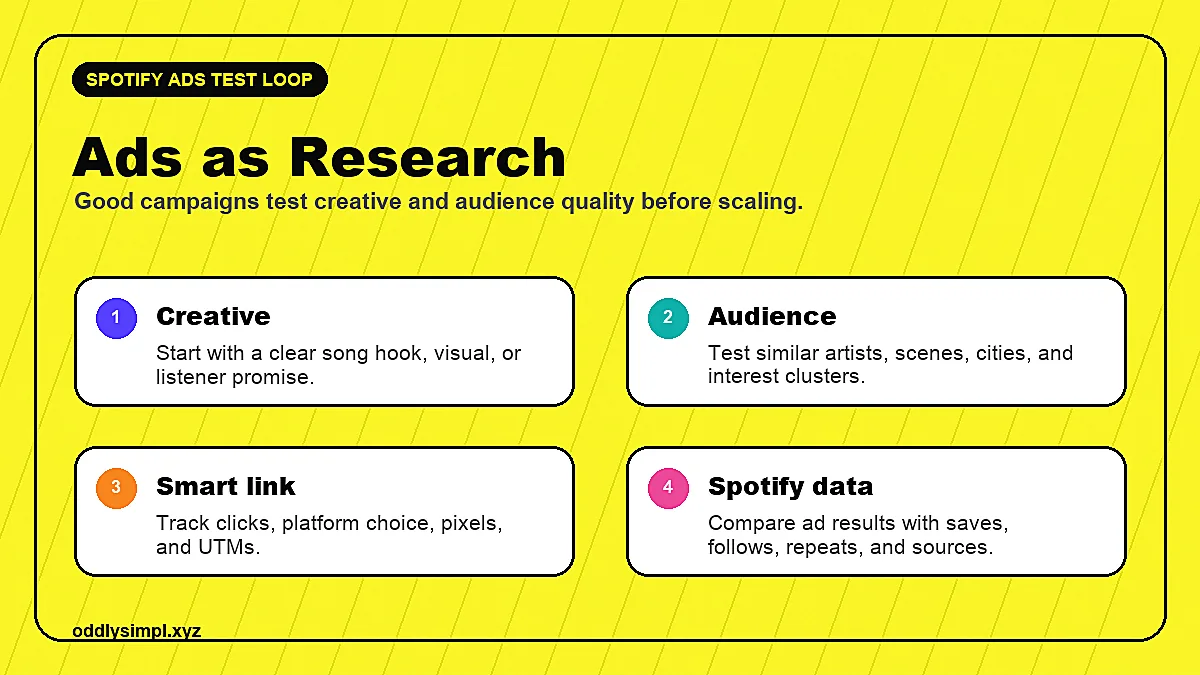
- Pick one job for the campaign. Are you testing a new audience, supporting release week, reactivating past listeners, or trying to grow followers before the next drop?
- Define the listener. Use genre, similar artists, cities, age range, and cultural context. "People who like music" is not targeting.
- Build creative around the moment. A release-week ad should sound different from a catalog ad, a tour ad, or a fan-retention campaign.
- Send traffic to the right place. Use a Spotify link, smart link, or release page depending on whether the campaign needs streams, platform choice, pixel data, or retargeting.
- Read the campaign after the first learning window. Do not scale because clicks are cheap. Scale when the downstream Spotify behavior makes sense.
What to measure besides streams
Streams matter, but they are not enough. If a campaign gets streams from people who never save, follow, replay, or return, the ad platform may be happy while the artist's long-term data gets weaker.
Watch these signals instead:
- Save rate: are new listeners deciding the song is worth keeping?
- Follower lift: are listeners raising their hand for the next release?
- Repeat listening: are people coming back after the first click?
- Source of streams: are streams coming from your profile, listener libraries, radio, algorithmic playlists, or suspicious passive sources?
- Fans Also Like movement: is Spotify grouping you near artists that make sense?
The music analytics guide goes deeper on how to read those signals without getting hypnotized by one metric. If you are trying to improve Spotify follow-through, pair the campaign with the guide on getting more Spotify followers and the explainer on Spotify Fans Also Like.
Common Spotify ad mistakes
- Chasing the cheapest country or audience: cheap traffic can look efficient and still teach Spotify the wrong thing.
- Promoting a weak landing path: if the listener has to think too hard, the campaign leaks.
- Using generic creative: "new song out now" is not a reason to care.
- Scaling before the data is clean: a good click-through rate is not proof of a good listener.
- Buying ads to fix a positioning problem: ads amplify the offer, the song, and the story already present.
Spotify ads vs playlist promotion
Playlist promotion can create a visible stream spike, but it often gives the artist less control over who listened and why. Spotify ads are more useful when you want controlled testing: different audiences, different creative angles, different cities, and clearer campaign learning.
Playlist activity still has a place, but listener behavior tells you whether the placement helped. Judge it by saves, follows, repeat listening, and source quality instead of the ego hit of seeing a big playlist name. For a broader breakdown, read the Spotify promotion services guide.
A simple starter budget
If you are testing paid growth, think in learning windows. A practical starter test might use 14 to 30 days, 2 to 4 creative angles, and a budget that is large enough to compare audiences without forcing you to panic after three days.
If the song starts producing clean saves, follows, repeat listening, and sensible audience patterns, scale carefully. If it only produces cheap clicks, stop and fix the creative, positioning, or targeting before spending more.
When to get help
Get help when you do not know whether the bottleneck is the song, the creative, the audience, the landing path, or the budget. That is where a campaign system matters more than knowing which button to click.
If you want the campaign built around real listener behavior, start with simpl's Spotify ads for artists. We help independent artists test audiences, read the data, avoid fake-growth traps, and turn each release into a better next campaign.
Keep building the strategy
-
Spotify ads for artists
Get a campaign built around real listener behavior, clean targeting, and honest reporting.
-
Music analytics
Judge ad performance by saves, follows, repeat listening, and listener quality.
-
Spotify promotion services
Compare ads, playlist pitching, submission tools, and safer ways to grow.
About the author

Anthony Pacheco
Anthony Pacheco is the founder of simpl., a former Sony Music analyst, and a Billboard-charting musician who has helped run 750+ artist marketing campaigns. He writes about real listener behavior, release systems, Spotify ads, and how artists can grow without fake playlist traffic.