Marketing Strategy · Updated July 3, 2026
How to Promote a Show: Concert Marketing Plan
A great set in an empty room does not do much for your music career.
Most artists know they need to rehearse. Fewer artists put the same intention into getting people through the door. They post a flyer once, mention the show in a Story, and then wonder why only friends showed up.
Show promotion works when you start early, repeat the message without sounding desperate, and give people a real reason to leave the house.
How to Promote a Show: Quick Answer
To promote a concert or local show, start at least two weeks out, publish the full details, create short-form content that makes the night feel worth attending, personally invite likely fans, coordinate with every artist on the bill, submit the event to local listings, add the show to your artist profiles, and capture emails, follows, content, and merch sales at the venue.
The goal is bigger than one ticket. Turn the live show into proof: people in the room, content for the next campaign, local fan data, merch buyers, and stronger demand for the next release.
Concert Promotion Checklist
| When | What to do | Why it matters |
|---|---|---|
| 3-4 weeks out | Confirm venue details, ticket link, lineup, set time, assets, and event page | Gives every partner one clean source of truth |
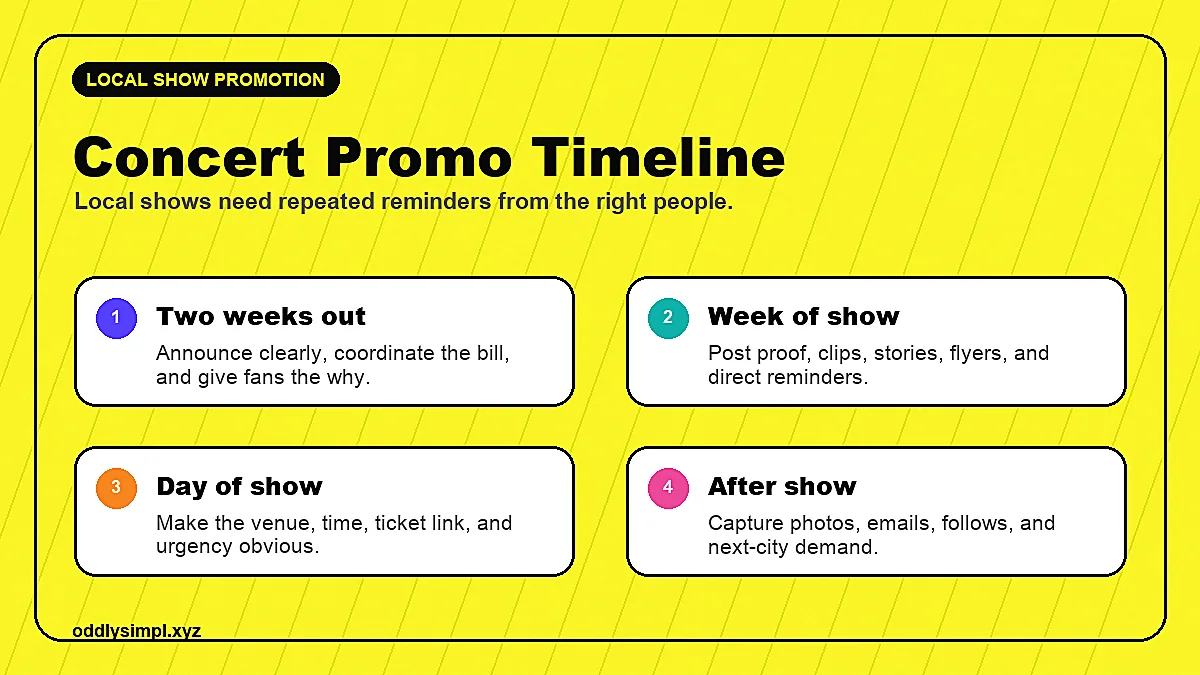
| 14 days out | Announce the show, text likely attendees, and ask the bill to cross-promote | Gets the show into people's plans before the weekend fills up |
| 7 days out | Post rehearsal clips, song snippets, local angles, and ticket reminders | Turns the event from a poster into a reason to care |
| 3 days out | Push urgency, local listings, Stories countdowns, and personal invites | Moves people from interested to committed |
| Day of | Post load-in, doors, set time, merch, and final ticket/door info | Captures late deciders and removes friction |
| After | Post recap clips, thank people, tag the bill, and follow up with new fans | Makes the next show easier to promote |
Start Two Weeks Out, Not Two Days
The common mistake is promoting the show after people have already made weekend plans. A Thursday night post that says "come see me play Friday" is too late for most people.
Build a promotional timeline that starts 14 days before the show and escalates as the date approaches:
- 14 days out: Announce the show with a proper graphic: venue, date, time, ticket link, and other artists on the bill.
- 10 days out: Post a rehearsal clip or behind-the-scenes moment. Make it feel real, not polished.
- 7 days out: Drop a teaser with a 15-second clip of a song you'll be performing, or a story about why this show matters.
- 3 days out: "This week" reminder post with the ticket link front and center
- Day before: Post a countdown with "tomorrow night" energy and urgency without desperation.
- Day of: Morning post, a brief live from the venue during load-in, and a final push right before doors
Six useful reminders over two weeks beat one hype post the night before.
Pro Tip: Personal invitations can convert 3 to 5x better than social posts. Five real conversations about your show will put more people in the room than 500 Instagram impressions.
Use Word of Mouth Without Being Weird
Word of mouth converts because people trust their friends. A personal invite from someone they know will beat most flyer posts.
The key is to make it feel like an invitation, not a pitch. You're not trying to sell tickets. You're inviting people into something worth showing up for.
Practical ways to use word of mouth without being that guy:
- Tell people in real life: friends, coworkers, and regulars at local spots. Keep it casual: "I'm playing at [venue] on Friday. You should come."
- Ask five people to personally invite five more people. A chain of personal invitations moves faster than any algorithm.
- Wear a band shirt out. See someone wearing music merch? Talk to them. Mention the show casually. These are your people.
- Text your list. Use personal messages to people who've come to shows before, not a mass blast.
How to Promote a Concert on Social Media
Social media show promotion fails when it looks like advertising. It works when it looks like content.
The goal is not to repeat the same flyer. The goal is to build anticipation. Every post should give someone a reason to care before they walk through the door.
Instagram and TikTok:
- Use the countdown sticker on Stories so followers can subscribe to get a notification when the clock hits zero.
- Poll your audience on what songs they want to hear live. This gives fans a small stake in the set.
- Share clips of songs you're playing. Use a raw rehearsal clip instead of only the studio version.
- Tag the venue. Tag the other artists on the bill. This gets your content in front of their audiences too.
- Go live briefly from the venue during soundcheck. Even 90 seconds of "we're about to go on" energy creates FOMO.
Facebook Events still have a place. Do not mass invite your friends list, but use the event page as a hub. It shows up in local search, gives people a place to RSVP, and reminds followers who said they were going. Create the event, share it once, and let it work passively.
How to Advertise a Concert Without Wasting Money
Paid ads can help a local show, but only when the targeting is tight and the show already has a clear reason to attend. Do not boost a generic flyer to a huge radius and hope. That creates cheap impressions, not people at the door.
Start small. Test a short video clip, a rehearsal moment, or a direct invite to people near the venue who already like similar artists, local music pages, the venue, or the other artists on the bill. Send them to one clean ticket link or event page. If you use a smart link or tracked ticket link, you can see which post or ad moved people.
For most developing artists, the best show ad is not "buy tickets now" to cold strangers. It is a warm push to people who already watched your videos, clicked a release link, follow you locally, or engaged with similar music.
How to Promote a Concert on Spotify
If your distributor, ticketing partner, or live-event platform connects to Spotify, make sure the show appears on your Spotify artist profile. Spotify followers can see upcoming events, and a live date gives existing listeners a real-world next step.
Do not treat Spotify events as the whole plan. Treat them as one piece of the fan path: someone hears the song, follows you, sees the show, clicks the ticket link, and then becomes easier to reach after the night is over.
Cross-Promote with Every Artist on the Bill
The other artists on the bill are part of the promotion plan.
If there are three artists on the bill and each of you has 500 engaged local followers, you have access to 1,500 people for the price of one conversation. Build real relationships with the other artists. Share each other's content. Tag each other in posts. Create a shared graphic that features everyone on the bill.
This is one of the most underused parts of local show promotion, and it costs nothing.
The connections you build with other local artists compound over time. Today's support slot is tomorrow's co-headline. The band you cross-promote this Friday will cross-promote your release next month. Treat every show like the beginning of a long-term relationship.
Flyers and Physical Promotion (Still Works in the Right Markets)
Depending on your genre and city, physical flyers still move people. Punk, metal, rock, hip-hop, and electronic scenes with strong local culture still respond to physical promotion.
Where to put flyers:
- Local record stores
- Other music venues (ask first)
- Coffee shops with community boards
- College campuses
- Skate shops, barber shops, tattoo parlors, or wherever your audience spends time
Ask the venue to include your show in their own email list and social posts. Most venues will do this because they want the room full too. This is free reach to an already music-minded audience.
Local Press and Event Listings
Local alt-weeklies, music blogs, and event listing sites need local content, and most artists never send them anything useful.
Send a brief pitch: your name, genre, show details, a one-paragraph bio, a press photo, and a streaming link. Keep it under 200 words. Most local press editors are managing enormous inboxes, so make it easy to say yes.
Beyond traditional press, submit your show to:
- Bandsintown and similar local/touring discovery platforms
- Your city's subreddit, where a specific "come see us play" post in a local music community can get real traction
- Facebook community groups for local music fans
- Spotify, where you can add the show to your artist profile so followers get a notification
Pro Tip: Update your Spotify artist profile with upcoming shows. Spotify notifies followers about your live dates. It is free, takes five minutes, and most artists skip it.
Day-Of Tactics That Turn Attendees into Fans
Getting people in the room is half the job. The other half is making sure they leave as fans who know where to find you next.
What to do the day of:
- Make your social handles visible. On your setlist poster, on a small sign near your merch, on your instrument case. Make it effortless for people to find you after the show.
- Ask the crowd to follow you on Spotify. Do it from the stage, mid-set or at the end. Make it a moment: "if you liked that, we're on Spotify as [Artist Name], follow us so you don't miss what's coming next."
- Collect emails. Use a sign-up sheet or QR code at your merch table. An email list lets you reach fans without waiting for an algorithm.
- Have merch available. Stickers and a small run of shirts can be enough. Merch gives people a tangible way to support you that night, and every person who leaves wearing your shirt becomes a walking advertisement.
- Get the show on film. Bring someone whose only job is to capture content: your full set, crowd reactions, and behind-the-scenes moments. This content becomes your promotional material for the next three months of shows.
- Engage after your set. Stick around. Talk to people. The artist who disappears backstage after their set leaves a very different impression than the one who's at the bar saying thank you. These conversations are where superfans are made.
The Show Is the Marketing
The show itself is a marketing event.
Every person in that room who has a great experience becomes a potential ambassador. They'll bring friends to the next show. They'll tell people about you. They'll share your content because they feel connected to what you're doing.
Playlist streams do not create that by themselves. Paid ads do not create that by themselves. A 45-minute live performance followed by real conversations can.
Local shows still matter because one room can create deeper connection than a passive stream count.
Promote with intent. Play like it matters. Follow up like a professional.
Pair show promotion with the bigger system: use a clean EPK for booking and press, read your city-level demand in music analytics, connect the show to your broader music release strategy, and pull ideas from the social media music promotion guide.
Local Show Promotion FAQ
How do you promote a local show?
Promote a local show by starting 2-4 weeks out, confirming one clean ticket link, posting repeated short-form reminders, personally inviting likely fans, coordinating with the bill, using local listings, and capturing fans at the venue.
How do you promote a concert on social media?
Promote a concert on social media with rehearsal clips, setlist polls, countdowns, venue tags, bill cross-promotion, local angle posts, day-of updates, and recap content that makes the next show easier to sell.
Should musicians run ads for a local show?
Musicians should run ads for a local show only when the targeting is tight, the creative gives people a reason to attend, and the ad points to one clean ticket or event link. A warm local audience is a better bet than a broad boosted flyer.
When should artists start promoting a show?
Artists should start promoting a show 2-4 weeks before the date, then increase reminders during the final week and capture content, emails, follows, and merch buyers on show day.
Ready to build real momentum around your music? Work with simpl. We build music promotion campaigns around real listener behavior, live demand, and useful fan data.
Keep building the strategy
-
Music marketing strategies
Build the full system around content, ads, release timing, and fan retention.
-
Music analytics
Use listener data to make better release, content, and ad decisions.
-
Spotify ads for artists
Turn the right listeners into repeat fans with a campaign built around your sound.
About the author

Anthony Pacheco
Anthony Pacheco is the founder of simpl., a former Sony Music analyst, and a Billboard-charting musician who has helped run 750+ artist marketing campaigns. He writes about real listener behavior, release systems, Spotify ads, and how artists can grow without fake playlist traffic.